English
 Deutsch
 Español
 Français
 Italiano
 日本語
日本語 Русский
 中文
中文
A Comprehensive Guide to Injection Molding Gates
- Published November 06 2025 - Updated September 07 2026
Gates for high volume precision injection molding.
When manufacturing high precision parts, the parts are made by the process of injection molding. The design of the part gates and their locations play a critical role in the part quality. This technical guide explains the various types of gates, how they are used and how to select the correct gates for your injection molding projects.
1. WHAT IS AN INJECTION MOLDING GATE?
In many cases the smallest part of the gating system is the molding gate. It is the smallest section through which the molten plastic is injected into the part (mold cavity) by the injection unit with high pressure. The molding gate is an opening in the wall of a mold. The part then fills up completely through this opening. After the part has solidified the gate is removed from the part. This remaining part of the shot is called a gate mark or sprue mark. This can be cut off or broken off. In some cases the gate mark has to be sanded off.
2. WHAT’S THE PURPOSE OF INJECTION MOLDING GATE?
A mold gate has several roles in the fill process. It has to allow molten material to flow from the tip of the injection unit through the runners and into the part cavity. It has to fill the cavity completely to form the part to exact specifications. If the part is not filled completely then there are a high chance of part defects occurring such as; part not filling completely (short shots) or part material leaking out from under the part ejection area and sticking to the injection molding machine. Also possible are excess material around part edges (flash) and uneven part surface finish. This is why the part gate is designed to be smaller than the thinnest cross-section of the part to control the material fill process. Should the part gate be made the same size or larger than the thinnest part cross-section then it would be extremely difficult to control the flow of material through the gate and into the part cavity. This could cause a host of problems during the fill process.
The gate is made smaller than the thinnest section of the part to keep control of the shot. Once the part has filled the cavity the gate becomes a constricting point in the part. Once the part has solidified the constricting point in the part will leave a residual mark on the part the same size as the gate. These residual’s can be removed from the part by secondary processing.
3. COMMON TYPES OF INJECTION MOLDING GATES
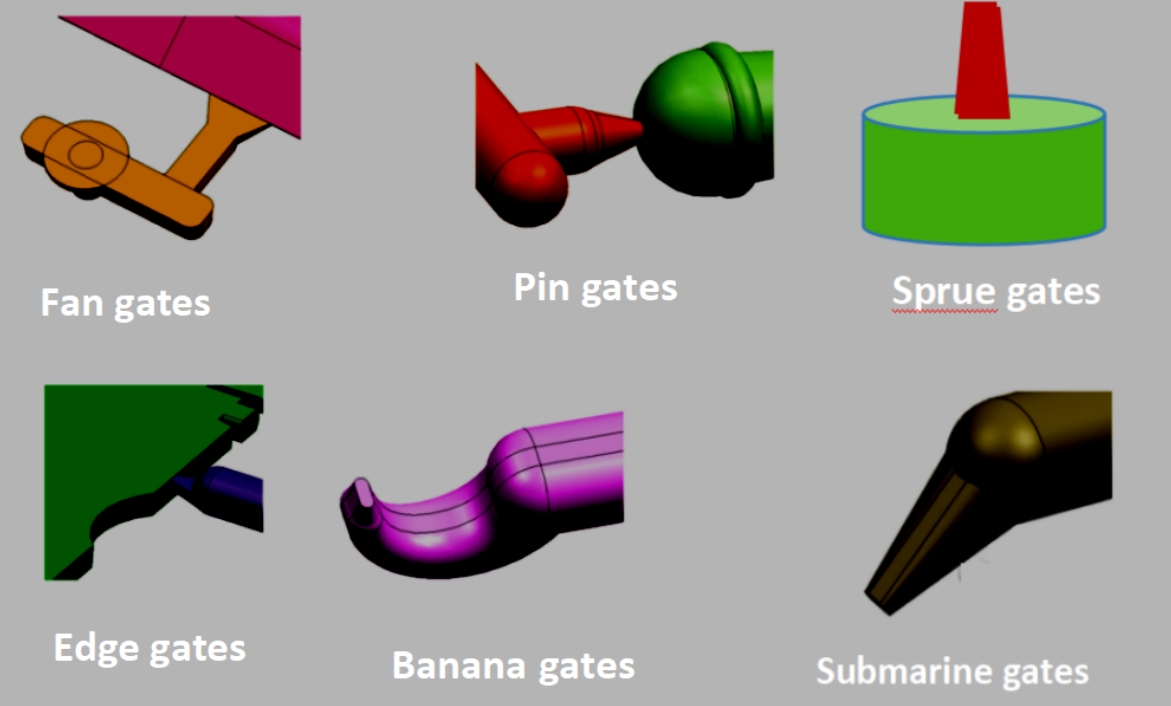
Gates for injection molding can be distinguished by their design. Depending on the required characteristics of a part (part, material, series production or surface finish), there are several types of gates that can be integrated into a mold. Spure-gates, edge-gates, submarine-gates, pinpoint-gates and fan-gates are the typical types of gates for an injection molding production.
-Spure Gates:
Sprue Gates are the most common form of an injection molding gate. The sprue gate is typically a conical shaped opening through the wall of the mold. The sprue gate is usually located in the thickest part of the mold, in order to fill the cavity perfectly. Sprue gates are generally very easy to use in the production of larger parts. The sprue gate is removed from the part after it has been used to form the part. The sprue gate can leave a noticeable mark or gate on the part. There are a limited number of locations on a part where a sprue gate can be used.
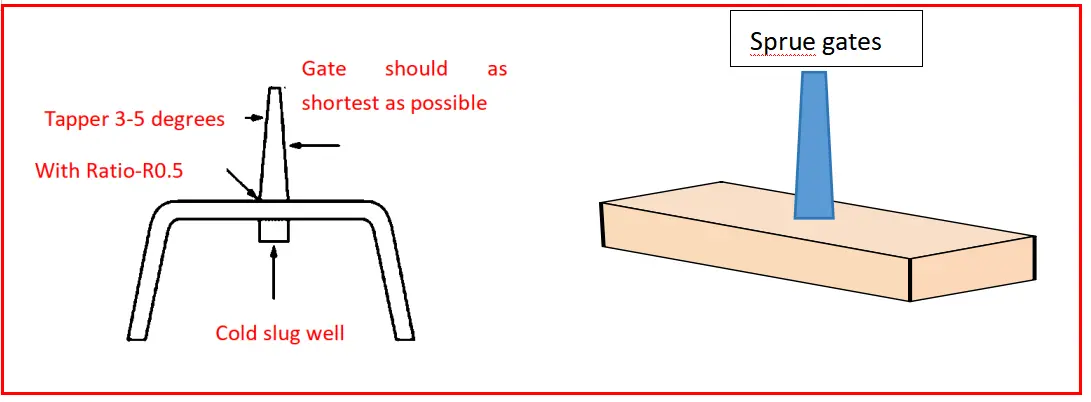
Injection molding sprue gate design illustrating proper gate taper, short gate length, cold slug well, and sprue gate placement.
– Edge gates:
Edge gates are used as part of the injection molding gates system. These are opened on the edge of the part. As the gates are opened on surface of part, there are marks on surface of part. Edge gates are very flexible, and there are many types of them.
– Submarine gates:
A submarine gate is a sort of gate that is completely covered up by the surface of the part or by a cavity that is nonvisible. It does not cause any marks on the surface of the part and is suitable for parts that are of complex design.
– Pinpoint gates:
Pinpoint gates, the smallest type of gates for injection mold parts, are so small that often they go through a hole as small enough for a needle to go through. The flow of molten material enters the part through the pinpoint gate, typically at the edge of the part. It is a means of hiding the typical gate mark left on the part by other types of gates. There are several types of gates that hide the typical gate mark, these include edge gates and submarine gates.
As Pinpoint gates are very small they can be a problem as they can become blocked with material. However pinpoint gates can be designed to try and reduce the amount of gate residue left on a part. This in turn can help to reduce part warpage and increase the surface finish of a part. This in turn will help to improve the quality of the part and reduce the amount of material waste.
– Fan gates:
Fan gates are typically used for large cavities where even flow to all points within the cavity is required. They are also good for parts that require to have a balance of molding performance and aesthetic appearance. The typical mark left from a fan gate is on the surface of the part, and this mark can vary in size.
4. FACTORS TO CONSIDER WHEN CHOOSING A GATE
The design of a part and the geometry of the part are determinants of the type of gate that is to be used. The part design, its dimensions, the overall shape, the wall thickness and other features on the part all must be considered. The requirements of the part are the key determinant of the type of gate that is best for that particular part.
Part Quality and Appearance:
Part Quality and Appearance: The position of the gates must be designed to either leave minimal gate marks on the part or to have the gate marks concealed. Edge gates and submarine gates are good choices for this type of part. Parts where the visibility of the gates is of no concern would utilize a sprue gate or possibly a fan gate.
Flow Control:
When designing a flow channel through a wall, similar characteristics of a gate must be evaluated. This includes suitable dimensions, appropriate shape, and required flow characteristics of a gate. These must be evaluated before the start of production in order to achieve a suitable balance between flow, pressure, and cooling.
Material Selection:
There are many types of mold materials. Each of the types of materials has a different melt flow index, a different melt temperature and different viscosity. This means there are many different types and sizes of gates to use for the different types of materials.
Production Volume and Cycle Time:
The design of the gate also has an influence on the production volume and on the time required for part production. When high quantities are to be produced, the gates should permit rapid injection molding and rapid cooling. Simple gates, which are easy to remove and need only a minimum of after-treatment (e.g. surface finishing) are best.
Cost Considerations:
During design of an appropriate gate for an injection mold also the cost-effectiveness has to be taken into account. Production costs for the mold with gates, the production efficiency and potential secondary machining operations to cut the gate off or for surface finishing have to be checked.
5. INJECTION MOLDING GATE DESIGN BEST PRACTICES
– Gate-to-part relationship:
The ‘gate-to-part relationship’ is a term of art within the context of the injection molding process. The ‘gate-to-part relationship’ is the relationship between the gate(s) of an injection mold and the parts that are being made by the mold. The critical points to consider with respect to the gate-to-part relationship are: 1) the position of the gate(s) relative to the part(s) and 2) the design of the gates relative to the required part features. The gate-to-part relationship is critical and will greatly affect the quality of the part(s) as well as potential post-processing requirements of the part(s). Care must be taken when designing the gates of a mold to consider the above points prior to the start of production.
– Weld lines and flow patterns:
Weld lines: Visible lines where the leading edges of the molten plastic have met. The flow of molten plastic through the mold cavity will determine where the weld lines will occur.
– Venting:
Mold venting can take the form of designed-in vents, or in the form of individual vent holes that are drilled in the core or cavity of the mold. Proper part quality is highly dependent on correct design of the venting in the mold, as the worst of molded part defects such as sink marks, wrinkling and surface finish problems are due to trapped air in the part as it is being injected.
6. TROUBLESHOOTING GATE-RELATED ISSUES
Problems caused by the gates in injection mold parts: gate blush, gate vestige and gate drool.
Gate Blush:
The gate temperature by adjusting various molding parameters (for example: melt temperature or molding speed) in order to minimize Gate Blush marks.
Gate Temperature: The cause of gate blush is the overheating of the gate. Reducing the gate temperature (melt temperature, injection speed, etc.) is enough to prevent gate blush marks on parts. The marks are especially visible on transparent or light-colored parts.
Gate Vestige:
Gate vestige or gate witness. The term describes a line or notch in a part of injection moldings which is left behind by a gate after it has been cut off from the part. The same causes are effective for this kind of defect as for gate blush. Thus, Gate Vestige can be alleviated by choosing the appropriate type of gate, by optimal placement of the gate, by the optimal design of the gate and by proper cutting of the gate. The appropriate tools have to be used for cutting the gate as well.
To minimize gate marks in parts you have to use a gate, which can be removed very easy, put it in the right place and try to keep the gate as small as possible. To remove the gate in the correct way you have to use the right tools for cutting off the gate.
Gate Drool:
Gate drool: This defect is characterized by leakage of the molten plastic from the gate or from the nozzle/sprue of the injection mold. This leakage takes the form of small droplets or of very thin strands of material. This type of defect typically arises from a number of causes including: the melt viscosity being too high, the type of gate being used, a lack of cooling to the gate area, and/or a lack of heat control at the nozzle/sprue area.
Adjusting the processing parameters (e.g. melt temperature, injection speed, back pressure) in order to reduce the melt viscosity could eliminate the gate drool. In addition, a nozzle (so called shut-off nozzles, valve gates) could be designed in order to close the sprue during the injection process in order to prevent such defects.
7. TO TROUBLESHOOT GATE-RELATED ISSUES IN INJECTION MOLDING:
• Increase the size of the gate to fill better or to counter overfilling.
• Before troubleshooting gates, try to optimize the position of the gates in order to fill the part as evenly as possible and to avoid defects.
• If the above fails to solve the problem, modifications to the part’s gate to better fill the part may be considered including the use of different types of gating.
• Control the gate temperature and vent air/gas to cool and vent as required.
• Refine the material and process data to reach an optimal flow and filling of the part.
• Clean, check and calibrate the individual parts of the gate of the mold in proper order.
8. TO MAINTAIN CONSISTENT GATE PERFORMANCE AND PREVENT BLOCKAGES IN INJECTION MOLDING:
• Check the area of the gate for signs of material buildup or for molding damage.
• Clean the gate after every production run.
• Remove blockages using appropriate tools and techniques.
• From time to time flush the injection mould gate and the corresponding system with plastic to get rid of unwanted impurities.
• Check all gate components for wear or damage.
• Optimize processing parameters to minimize material buildup.
• Ensure proper alignment of gate components.
• Follow manufacturer guidelines for maintenance and cleaning.
CONCLUSION
The gates of an injection molding part are a critical component. By learning about the different types of gates and their characteristics, and how to troubleshoot any problems with them, one can improve how they make their injection molded parts. When choosing a gate for a part and designing that gate, there are several things that one must take into consideration including the part’s design, the part’s material, how many of that part one intends to make, and the part’s aesthetic.
Continuing to learn more about the different types of gates used in injection molding, and how to apply them in your own work, can be a very valuable learning experience, especially if you are able to discuss your findings with an experienced molder of plastic parts.