English
 Deutsch
 Español
 Français
 Italiano
 日本語
日本語 Русский
 中文
中文
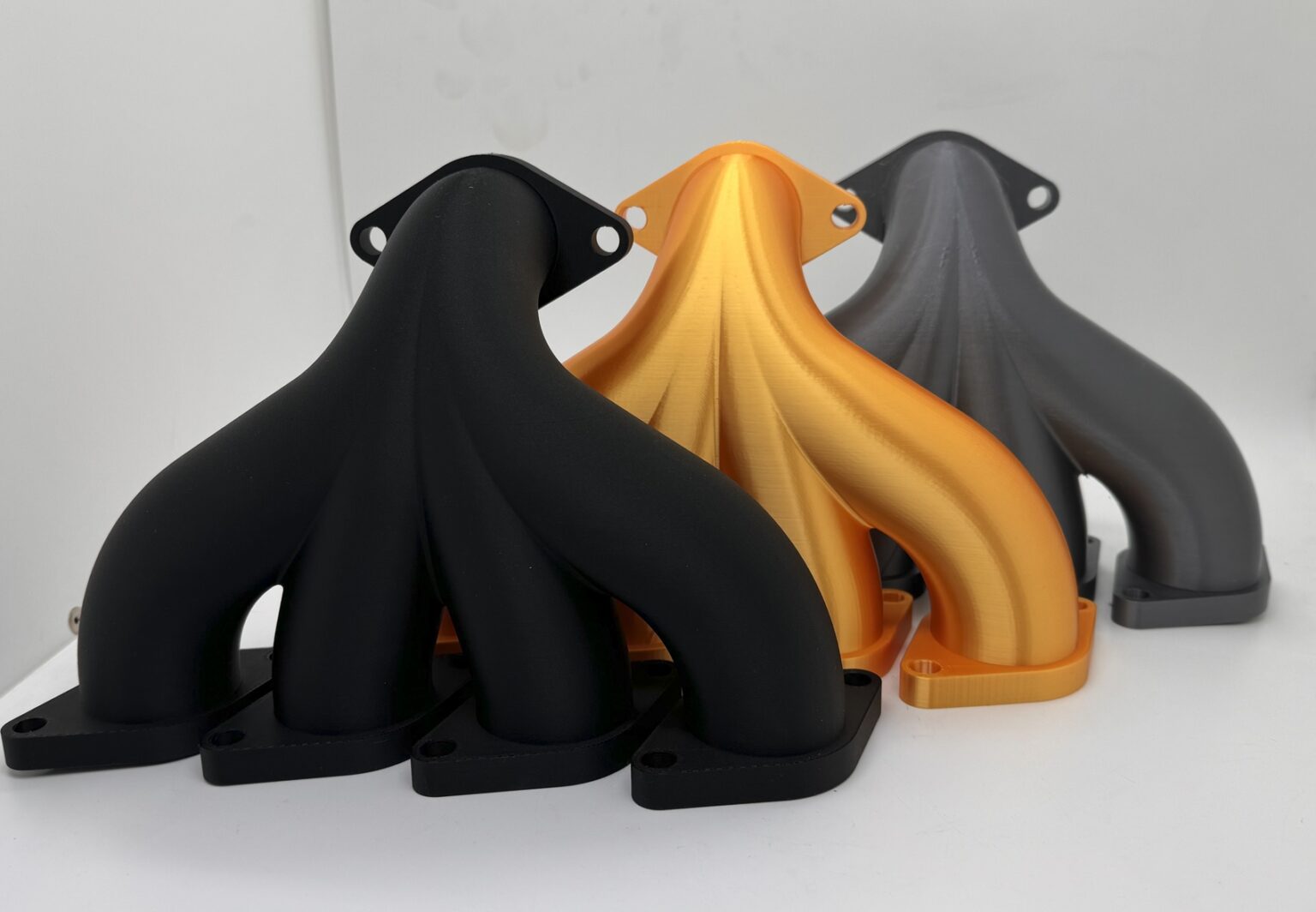
FDM vs. SLA vs. SLS: Which 3D Printing Technology Should You Choose?
- Published November 06 2025 - Updated August 14 2026
Let’s explore the differences of FDM, SLA, and SLS processes.
In 3D printing, choosing the right printing technology is crucial to the success of your project. The most used 3D printing technologies are FDM Fused Deposition Modeling, SLA Stereolithography, and SLS Selective Laser Sintering. Each technology has its advantages, disadvantages and suitable applications. This blog will analyze the differences between them in detail to help you make the best choice.
1. FDM FUSED DEPOSITION MODELING 3D PRINTING
Fused Deposition Modelling FDM 3D Printing is currently the most widely used additive manufacturing technology. It is particularly suitable to rapid prototyping and low-cost applications.
Materials that can be printed using FDM technology 3D printing include ABS, ASA, carbon fibre, PETG, PLA, PC, PP, PEEK, PPS, PPSU, PEI, POM, NYLON 12/66, and TPU/TPE (70A, 85A, 92A, 98A and 65D are all available through IN3DTEC’s 3D printing service).
FDM printing technology has a lot of advantages. It is cost-effective and widely used. It is relatively simple to operate and has lots of thermoplastic materials to choose from. So, this technology is particularly well-suited to functional prototypes and parts with low tolerances.
The disadvantages of FDM printing technology are that, compared with SLA and SLS printing technology, it offers lower resolution and surface finish on printed parts, with visible layer lines and limitations on geometric complexity. Consequently, this technology is best suited to the rapid and cost-effective manufacturing of prototypes, basic mechanical parts, early-stage product development, and the manufacture of jigs and fixtures.
FDM printing technology is widely used in industries such as consumer product casings, automotive test parts, educational and concept models, and jigs and fixtures.
2. SLA STEREOLITHOGRAPHY 3D PRINTING
Stereolithography SLA 3D Printing technology uses an ultraviolet laser to cure liquid resin into solid parts. This technology enables high-precision printing and the reproduction of fine details.
The main materials suitable for SLA printing include Standard ABS, Tough ABS, Somos Evolve, Somos Ledo, Somos Taurus, Ceramic.
Stereolithography 3D Printing technology has a lot of advantages. Parts produced by this technology have excellent resolution and surface finish, rendering them optimal for parts with comlicate details and complex structures. Furthermore, due to its tight tolerances, it requires very little post-processing.
SLA additive manufacturing technology also has some disadvantages to consider. It is more expensive than FDM manufacturing, and the material is brittle. Compared with FDM thermoplastics, the choice of resins is limited. Consequently, this technology is best suited to printing highly detailed 3D models, dental and medical components, visual prototypes and molds etc.
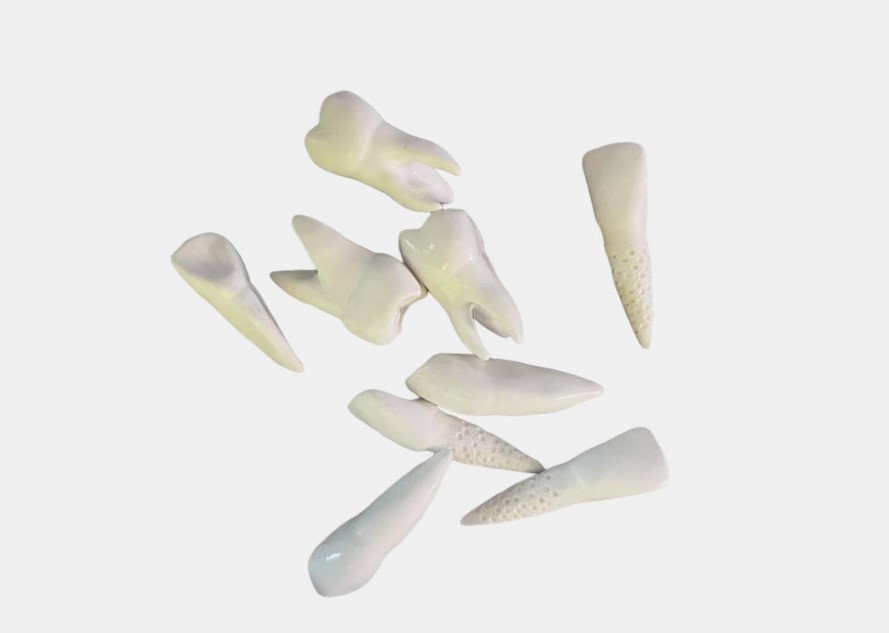
This technology is widely used in the manufacture of dental molds and braces, casings and housings for various products, jewelry prototypes, medical device casings, and high-detail 3D display models etc.
3. SLS SELECTIVE LASER SINTERING 3D PRINTING
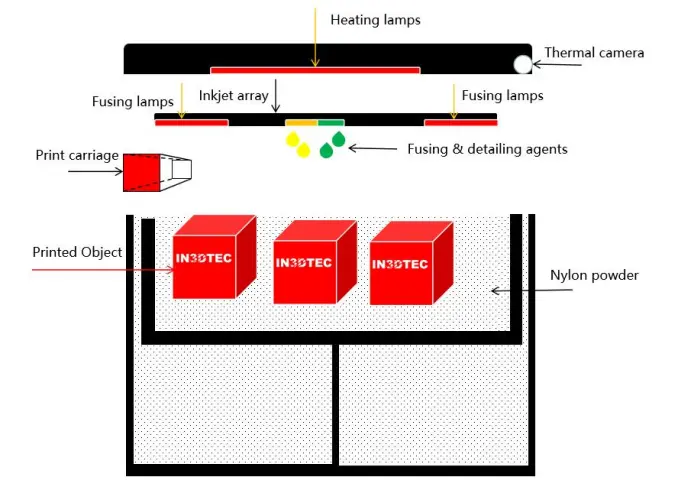
Selective laser sintering SLS 3D Printing technology uses a high-power laser to fuse powdered material (usually nylon) into solid parts. As this process does not require support structures, it is suitable for the manufacture of complex geometries.
Materials commonly used for SLS printing include nylon, nylon + GF, nylon + CF, PP, PEEK and TPU.
Components manufactured by SLS manufacturing technology have the advantages of high strength, high functionality and excellent mechanical properties. As no support structures are required during the printing process, this method is particularly well-suited to the manufacture of complex assemblies and interlocking components.
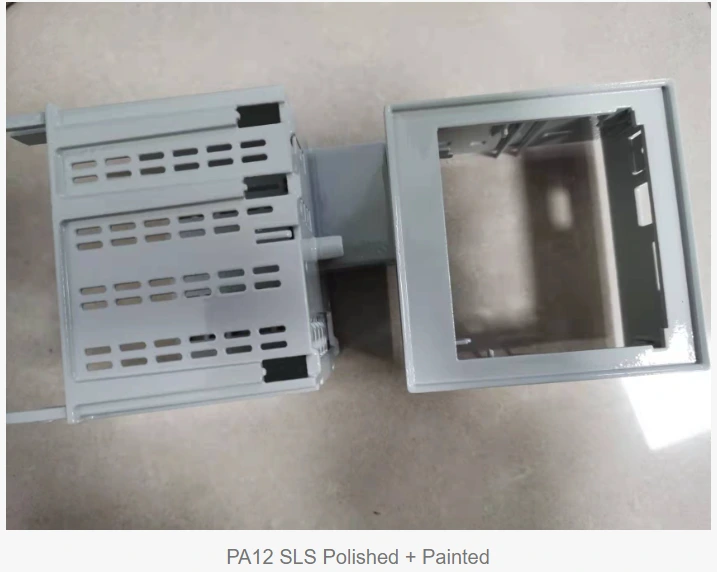
However, Selective Laser Sintering 3D Printing technology is relatively expensive, and the equipment is quite complex to operate. The surfaces of the printed parts are rough and may require post-processing, this may cause a long lead time. Consequently, this technology is best suited to the printing of end-use parts, mechanical components, small-batch production and functional prototypes.
This technology is widely used in the manufacture of aerospace brackets and casings, medical device components, functional gears and hinges, and components for drones and robots.
4. WHICH SHOULD YOU CHOOSE?
If you require a low-cost and rapid solution for early-stage designs, please choose FDM manufacturing. This technology is also suitable for mechanical parts that do not require high precision.
When you need to reproduce fine details and smooth surfaces, or for prototype models intended for demonstrations or assembly testing, please choose SLA additive manufacturing.
If you wish to print parts with complex geometries or functional load-bearing parts for small-batch production, please choose SLS Selective Laser Sintering 3D Printing.
Still unsure? Please contact our team at sales@in3dtec.com – we will help you match your design with the right technology based on your budget, timeline and performance requirements.