English
 Deutsch
 Español
 Français
 Italiano
 日本語
日本語 Русский
 中文
中文

Painting vs Powder Coating
- Published November 06 2025 - Updated September 19 2026
A comparative analysis of application processes, durability, environmental impact, and industrial suitability for surface finishing.
There are two common methods for adding protective and decorative coatings to various surfaces: painting and powder coating. How do you choose the right method for your specific application?
This article will explore the differences between painting and powder coating, analyzing their processes, advantages, disadvantages, and environmental impacts. By getting to know the special characteristics of each method, you can better determine which one best suit your specific needs.
1. WHAT IS PAINTING?
Painting refers to the process of applying liquid paint to the surface of an object using brushes, rollers, or spray guns. Paint consists of pigments, binders, solvents, and additives. Painting can be done manually or by automated systems. The process requires skilled operators and can be time-consuming.
Paint adheres to the surface through mechanical bonding and chemical reactions, and its thickness depends on the desired coverage, typically ranging from a few micrometers to tens of micrometers. Painting requires a drying and curing process to achieve full hardness and durability. Painting can achieve a variety of surface finishes, including matte, satin, and glossy. It allows for personalization through a wide range of colors, textures, and effects.
Most paints may contain volatile organic compounds (VOCs), which result in air pollution. Water-based paints are a more environmentally friendly option.
Painting offers excellent value for money, ease of use, repairability, and a wide variety of colors and finishes to choose from.
However, compared to powder coating, painted surfaces may be slightly inferior in terms of durability, scratch resistance, peeling resistance, or corrosion resistance. It is also more time-consuming, requiring specialized skills and experience, as painting requires drying time, which is longer than powder coating. Furthermore, it has a negative environmental impact.
Painting is good for applications in art and creative industries, home and interior design, the automotive industry, consumer electronics, furniture and cabinetry, signage and advertising etc.
2. WHAT IS POWDER COATING?
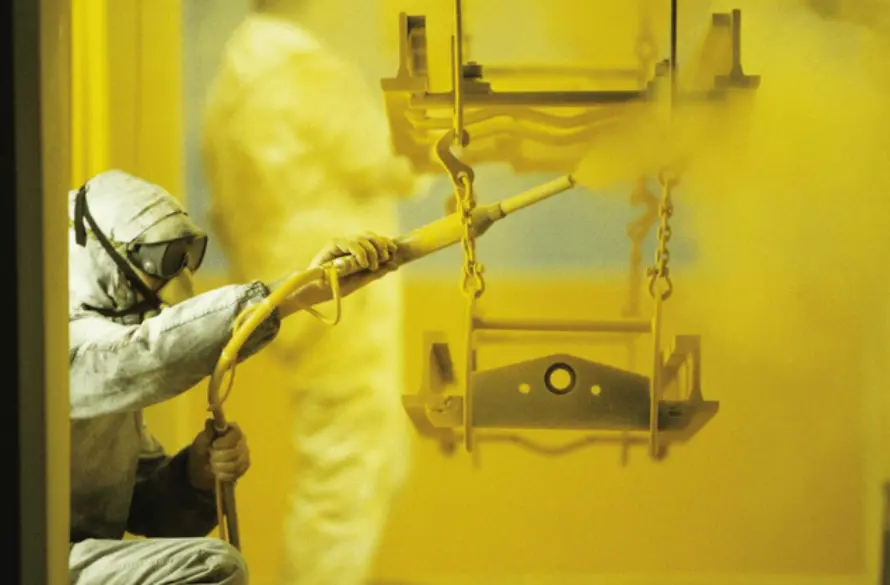
Powder coating is a process in which dried, finely ground, colored coating resin particles are electrostatically sprayed onto the surface of an object. These particles are charged by the spray gun, thus adhering to the surface. Excess powder is then removed, and the coated object is baked in an oven.
Powder coating relies on electrostatic attraction and heat to form a strong bond between the powder and the substrate surface. Powder coating provides a durable and aesthetically pleasing surface finish with a smooth, uniform appearance. It offers a variety of colors and surface treatments, including textured and metallic options. Powder coatings are typically thicker than traditional liquid coatings, ranging from 20 to 200 micrometers.
The powder coated part is baked at a high temperature (typically around 200-220°C (390-430°F)) to melt and fuse the powder particles into a continuous coating film.
In contrast to conventional coating methods, powder coating is considered more environmentally friendly. Excess powder can be reused, reducing volatile organic compound (VOC) emissions and waste generation.
Powder coating is cost-effective and durable for high-volume production of parts. It is faster than painting, but has a longer preparation time, though it is more environmentally friendly.
However, compared to painting, the color selection is limited, and the preparation cost is higher. Furthermore, proper surface treatment is required after powder coating, and defects are difficult to repair.
Powder coating is great for applications in construction and building materials, outdoor furniture and appliances, industrial equipment and machinery, medical and laboratory equipment, retail display racks and shelves etc.
In summary, both painting and powder coating are effective methods for providing protection and enhancing the appearance of various surfaces. When choosing between spray painting and powder coating, factors such as desired surface finish, application method, durability, environmental impact, and specific project requirements must be considered.
CONCLUSION
In conclusion, both painting and powder coating are effective methods for adding protection and enhancing the appearance of various surfaces. When choosing between painting and powder coating, it is essential to consider factors such as the desired finish, application method, durability, environmental impact, and specific requirements of the project.