English
 Deutsch
 Español
 Français
 Italiano
 日本語
日本語 Русский
 中文
中文
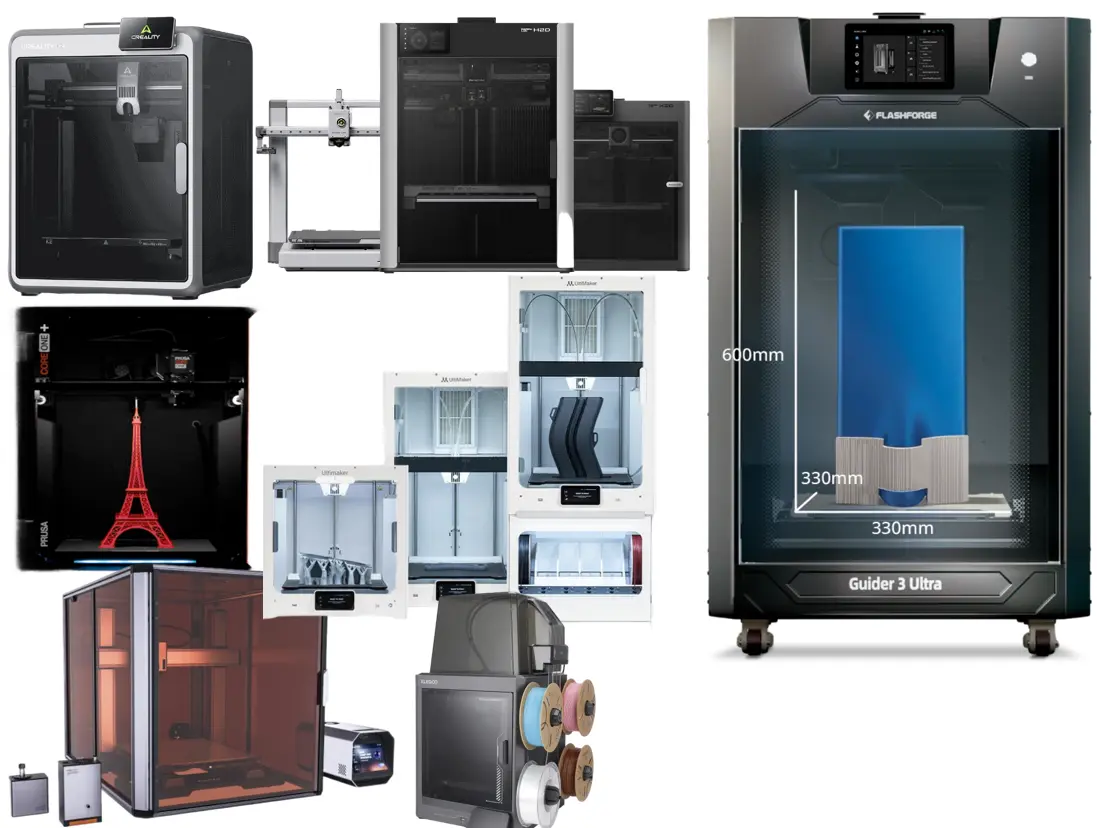
Top 3D Printing Brands in 2026: FDM Desktop Printer Comparison & Buying Guide
- Published June 01 2026 - Updated June 01 2026
Compare leading FDM 3D printer brands for performance and value
Since 2014, FDM 3D printing has shifted from a niche prototyping technology into a mainstream manufacturing tool used by engineers, designers, educators, and small production teams.
By 2026, the market has clearly consolidated into a few dominant ecosystems:
- High-speed consumer ecosystems
- Open-source and maker-driven platforms
- Budget mass-market manufacturers
- Industrial-grade professional systems
This guide breaks down the most relevant FDM 3D printer brands in 2026, not as a ranking, but as a use-case based comparison to help engineers and buyers choose the right ecosystem.
1. HOW TO CHOOSE AN FDM 3D PRINTER (2026 BUYING FRAMEWORK)
Before comparing brands, it’s important to understand the key selection criteria used by engineers and product teams:
Speed & Productivity
- Print speed and acceleration
- Multi-material or multi-color capability
- Automation (auto calibration, filament systems)
Reliability & Maintenance
- Out-of-box stability
- Failure rate and downtime
- Spare parts availability
Ecosystem & Software
- Slicer software flexibility
- Community support
- Third-party compatibility
Build Volume & Material Capability
- Maximum print size
- Engineering material support (ABS, PC, nylon, composites)
Cost of Ownership
- Hardware price
- Maintenance cost
- Consumables and ecosystem lock-in
2. HIGH-SPEED CONSUMER ECOSYSTEMS
1. Bambu Lab (China)
Bambu Lab represents the new generation of consumer FDM printers, built around automation, speed, and closed-loop system design.
Positioning
A plug-and-play high-speed ecosystem designed for productivity-focused users.
Strengths
- Extremely fast and stable printing system
- Advanced multi-color ecosystem (AMS)
- Strong software integration
- Minimal setup required
Limitations
- Closed ecosystem with limited third-party flexibility
- Reduced slicer parameter control for advanced users
- Increasing dependency on proprietary parts
2. Elegoo
Originally a resin 3D printing leader, Elegoo has expanded aggressively into the FDM segment with a strong cost-performance strategy.
Positioning
Budget-friendly high-volume FDM manufacturer with open-source alignment.
Strengths
- Very competitive pricing
- Klipper-based high-speed systems
- Large build volume options
- Rapid product iteration
Limitations
- Quality consistency may vary by batch
- After-sales support varies by region
- Less mature ecosystem compared to top-tier brands
3. Creality
Creality remains one of the largest FDM printer manufacturers globally, known for making 3D printing accessible to the mass market.
Positioning
Entry-level to prosumer mass adoption platform.
Strengths
- Extremely wide product range
- Low entry price
- Huge global user community
- Strong aftermarket modification ecosystem
Limitations
- Quality control inconsistency across models
- Requires user tuning and maintenance
- Fragmented product lineup
3. OPEN-SOURCE & MAKER-ORIENTED PLATFORMS
1.Prusa Research
Prusa remains one of the strongest open-source hardware ecosystems in the desktop FDM space.
Positioning
Open-source, repairable, and community-driven 3D printing platform.
Strengths
- Fully open hardware and software ecosystem
- High reliability and long-term durability
- Strong documentation and support
- Excellent print consistency
Limitations
- Higher price compared to Asian competitors
- Slower release cycles
- Less aggressive innovation in speed-focused features
2. Snapmaker
Snapmaker focuses on modular manufacturing systems combining 3D printing, laser engraving, and CNC machining.
Positioning
Multi-function fabrication system for makers and small studios.
Strengths
- 3-in-1 modular design
- Strong mechanical build quality
- Open-source friendly ecosystem
- Expanding multi-head capabilities
Limitations
- Higher system complexity
- Additional accessories required for full functionality
- Software maturity still evolving
4. PROFESSIONAL & INDUSTRIAL DESKTOP FDM SYSTEMS
1.UltiMaker
UltiMaker is widely used in professional environments where reliability and precision are more important than speed.
Positioning
Professional-grade FDM platform for engineering and education.
Strengths
- High dimensional accuracy and consistency
- Strong integration with Cura ecosystem
- Reliable long-term operation
- Dual extrusion capability
Limitations
- High price point
- Slower innovation in speed and automation
- Limited consumer-oriented features
2. BCN3D
BCN3D is known for its unique IDEX (Independent Dual Extrusion) technology, enabling mirrored and duplicated printing.
Positioning
Engineering-focused dual extrusion manufacturing system.
Strengths
- True independent dual extrusion system (IDEX)
- Efficient small-batch production capability
- Strong industrial use cases
Limitations
- Higher price barrier
- Smaller community ecosystem
- Slower software iteration
5. HYBRID & EMERGING ECOSYSTEM PLAYERS
Flashforge
Flashforge has built a strong presence in education and stable desktop FDM systems.
Positioning
Reliable plug-and-play printers for education and small businesses.
Strengths
- Stable out-of-box experience
- Low failure rate
- Strong education market presence
Limitations
- Less aggressive innovation
- Smaller maker community compared to Prusa or Creality
6. WHEN NOT TO BUY A 3D PRINTER
Despite rapid improvements, desktop FDM printers still require:
- Material understanding
- Slicing knowledge
- Mechanical maintenance
If your goal is to validate designs or produce parts without hardware investment, outsourcing may be more efficient.
7. PROTOTYPE WITHOUT HARDWARE INVESTMENT (IN3DTEC)
For engineers and product teams who want to test designs before purchasing equipment, online manufacturing services provide a practical alternative.
IN3DTEC is a digital manufacturing platform trusted by over 15,000 engineers worldwide, offering:
- FDM 3D printing
- Resin (SLA/LCD) printing
- Industrial metal 3D printing
With instant online quoting and production-grade manufacturing support, teams can move from CAD to physical parts without upfront hardware investment.
Upload your 3D file and get an instant quote to start prototyping faster.