English
 Deutsch
 Español
 Français
 Italiano
 日本語
日本語 Русский
 中文
中文
Designing Undercuts for Injection Molding: A Comprehensive Guide
- Published November 06 2025 - Updated August 27 2026
No Routing Required Injection Moulding Technical Roadmap - Managing complex geometry with side-actions, lifters and part geometry optimisation.
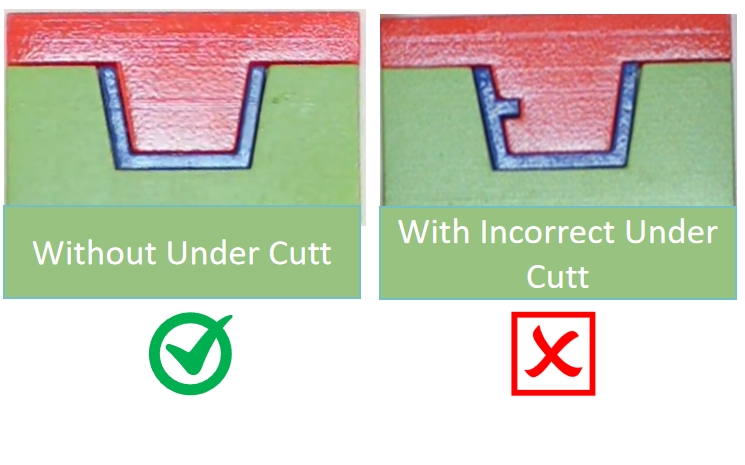
Designing undercuts is an important aspect to consider when designing and manufacturing a part for injection molding. By creating undercuts, you can increase the complexity of the part’s ejection from the mold, therefore it is important to understand the effective ways to design undercuts. The following guide to designing undercuts in injection molding outlines the major considerations to take into account.
1. WHAT ARE UNDERCUTS IN INJECTION MOLDING?
The goal when designing undercuts is to lock a part in the mold so that it cannot exit the mold in normal ejection. In general, undercuts are designed using features such as side holes, tabs and other internal features including threads and other geometric features that are classified as undercuts. Locking a part in a mold using undercuts usually needs the need for special ejection methods.
2. WHY ARE UNDERCUTS CHALLENGING?
The ejection of a part from an undercut increases the complexity of the part, the injection mold and the process of the injection molding. Also, the risk of a damage to the part as well as to the injection mold, is greatly increasing with undercuts. Last but not least, the cycle time will be increased for parts with undercuts.
3. WHEN UNDERCUTTING IS INEVITABLE, HOW SHOULD WE DESIGN?
Top Tips for Designing Undercuts
1.Use Side-Actions and Lifters
As well as forming the undercuts, the part must also be released from them. This is done by providing side-actions and/or lifters in the mold.
Side-actions move perpendicularly to the open direction of the mold and therefore are the preferred method for external undercuts. The function of a side-action is to move into the undercut just before the part is ejected from the mold. After the part has been ejected, the side-action automatically retracts.
Internal undercuts are typically released by lifters. These part releasing elements are typically moved at an angle in order to have optimal contact with the lower edge of the part. In the opening phase of the mold the lifter is lifted away from the undercut in order to release the part which then can be ejected from the mold cavity.
As an alternative, these parts should be avoided in the design wherever possible as these components are very expensive to include in a mold.
2.Incorporate Draft Angles
The design of parts with undercuts includes the consideration of the required draft angles on surfaces adjacent to the undercut. For internal undercuts a minimum of 1° to 2° is usually needed, whilst external undercuts can also be supplied with similar draft angles depending upon the complexity/depth of the undercut.
For internal undercuts a minimum of 1° to 2° draft angle is recommended.
External undercuts will also need to have draft angles created on the external surface of the component. These angles are typically between 1-2 degrees and should be reviewed by an IN3DTEC expert to ensure the most effective design for your specific application.
For complex undercuts please contact an IN3DTEC expert to specify required draft angles.
3. Use Flexible Mold Materials
Some flexible mold materials, called elastomers, can even fill undercuts. The way these materials can slightly deform when the part is being ejected from the mold, allows for the removal of the part from the mold without any additional mechanical features. Elastomers are typically limited to small runs and best used for undercuts with simple features and of relatively small depth.
Flexible molds are mainly used for small production runs or simple parts with very small undercuts.
4. Optimize Part Geometry
The designer of the part must take into consideration when designing undercuts how they are going to be used to mold the part. The designer should attempt to make undercuts as easy as possible to mold. The designer should attempt to make the undercuts as shallow as possible. The less details that the part has the better for the designer. Simple part geometries are the best for undercuts. Also all undercuts should be designed so that they are in line with the parting line of the mold.
Using CAD software to model the part and the process of injection molding for that part can point out possible problems before they occur.
5. Material Considerations
The material has to be selected with the undercuts in mind. The material can shrink in a different way during the cooling down period after the injection, which can cause problems for the design of the mold and for the dimensions of the part that is being produced.
There are several materials that can be used when making parts with undercuts. Most of the parts made with the injection molding process are made from a type of thermoplastic. They are flexible and are very durable. The elastomeric type of material is also very flexible and can handle very complex undercuts. These types of materials are very pliable and can bend to fit in very small spaces. The last type of material that can be used are the thermosetting type of plastics. These types of plastics are very rigid and need to be design differently than the other types of materials.
Note: For further information on any of the injection molding materials listed above, please contact us.
CONCLUSION
Designing parts with undercuts can be challenging for the injection molding process. However, with the use of side-actions and lifters, with the implementation of draft angles, with the use of flexible mold materials and with an optimal part design, parts with undercuts can be injection molded without problems.
Designing undercuts for injection molding is a critical process. Undercuts need to be carefully designed and it is very important to have a good mold design. For any questions on how to design undercuts for a specific part or for any questions on mold design, please do not hesitate to contact us at IN3DTEC.