English
 Deutsch
 Español
 Français
 Italiano
 日本語
日本語 Русский
 中文
中文
How Much Does SLS 3D Printing Cost? Low Volume Pricing Insights
- Published November 06 2025 - Updated August 27 2026
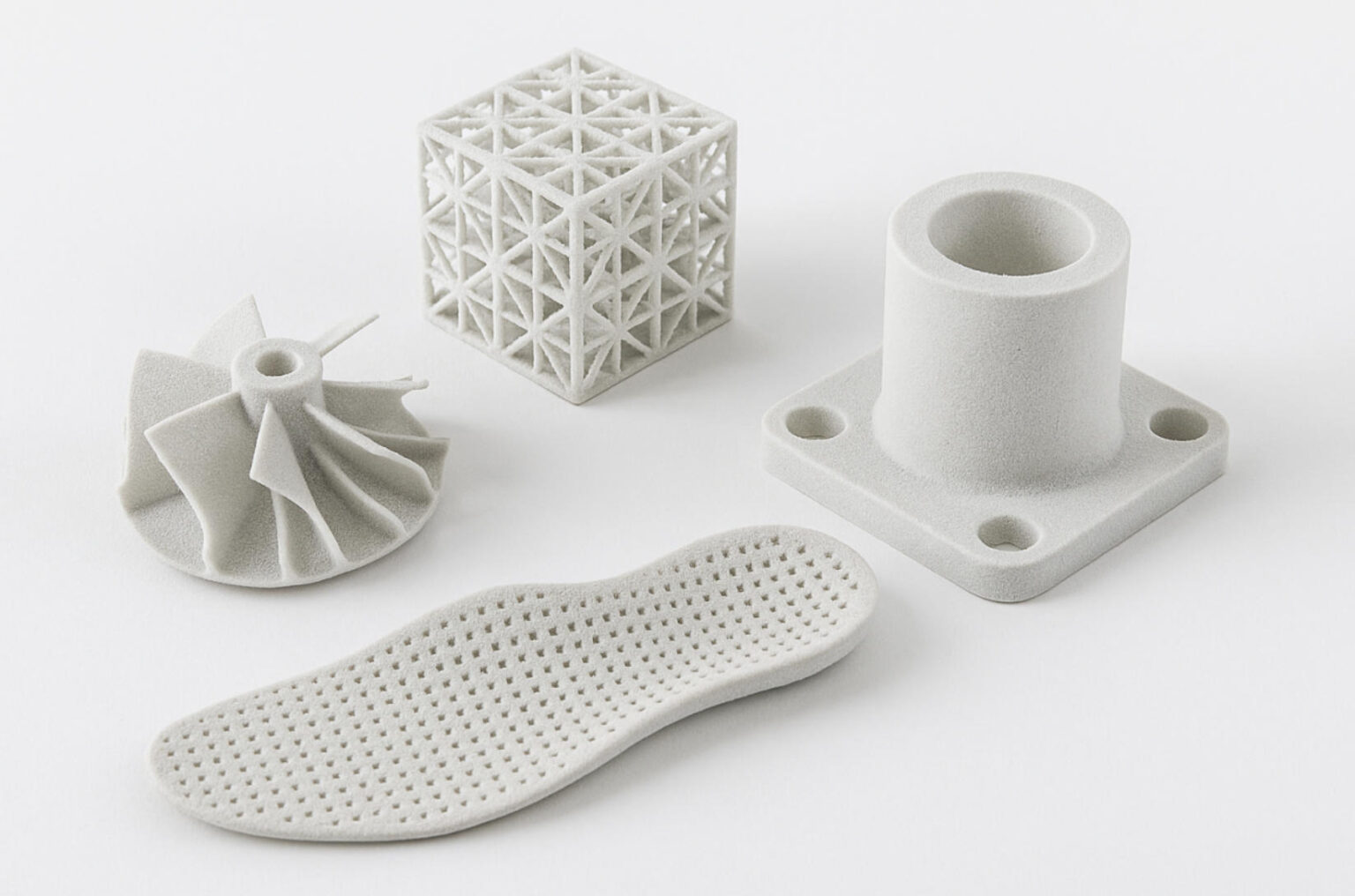
Selective Laser Sintering (SLS) is one of the most versatile 3D printing technologies today and is widely used to make prototypes as well as functional parts and for production in small runs.
Selective laser sintering SLS 3D printing is one of the most common additive manufacturing technologies and is used for the production of prototypes, functional parts as well as for small-batch production. One of the most common questions from customers of Selective Laser Sintering 3D printing is: how much does SLS 3D printing cost?
The price for a SLS manufacturing service can vary a lot depending on several factors. First of all, the cost of the SLS 3D printing service is determined by the material that is used for the 3D printing of your parts. Moreover, the volume, complexity and surface finish of your parts and the number of parts that you need also play a role in the total cost for your SLS printing project. In this article we will explain all the factors that play a role in the costs for the SLS 3D printing services offered by 3D Hubs and go into more detail on the costs for small-scale Selective Laser Sintering printing projects.
KEY FACTORS THAT INFLUENCE SLS 3D PRINTING COSTS
1. Material Selection
As with most additive printing materials, the price of Selective Laser Sintering materials vary greatly, depending on the desired characteristics and specific applications. PA12, or Nylon 12, is the most commonly used SLS material, due to its good mechanical properties and versatility. It is the most affordable of all the available SLS materials. Other materials, such as PA11 (biocompatible and flexible), TPU (Thermoplastic Polyurethane) (resilient and flexible), Carbon fibre-reinforced nylon (strong and rigid, ideal for high-performance engineering components) and PP (polypropylene) (lightweight and chemically resistant), are more expensive than PA12, with PP being priced in the middle, and the others being more expensive.
Learn more SLS 3D Printing materials and selection guide>>
2. Part Volume and Quantity
While processing costs for Selective Laser Sintering are largely determined by the volume of parts to be produced within the build chamber, there are however significant differences between processing small parts and large parts. In contrast to other manufacturing processes such as CNC machining or injection molding, SLS has very few set-up costs. Therefore, for equal processing volume, larger parts are more cost-effective than smaller parts. This makes SLS a very cost-effective solution for small-batch production.
3. Geometry and Complexity
The SLS printing process offers great freedom when it comes to the design of products. Due to the layer-wise manufacturing process, parts with complex geometries can be produced without any problems. Supports, which are typical for other 3D printing and additive manufacturing processes, are generally not required for Selective Laser Sintering parts. In some cases, however, extreme geometries, thin walls or deep cavities may require special processing. In such cases, additional tests may be required to check the stability of the part, or the part may need to be reinforced.
4. Post-Processing and Finishing
In SLS manufacturing, the surface finish of the parts is a parameter that can be very important to the customer. The standard surface finish of SLS parts has a rough surface and a grainy texture, which in many cases is not acceptable. However, the surface finish of the parts can undergo additional surface processes, which are typically very expensive. Common surface processes for smoothing the surface are bead blasting, dyeing or coloring. High-end surface processes, such as Vaporfuse smoothing or even CNC machining finishing and coating are usually used for consumer products.
5. Production Scale
For low volume production of individual parts, such as tens or hundreds of identical components, SLS manufacturing is likely to be the most cost effective manufacturing process. This is because no tooling is required for production of small batches unlike with small batch production of injection molded parts.
TYPICAL PRICE RANGES FOR LOW-VOLUME SELECTIVE LASER SINTERING 3D PRINTING PROJECTS
Please note that we have provided approximate price ranges for SLS parts below. These prices are variable depending on the suppliers used.
• Small parts (5–10 cm) in PA12: $2–$20 / part (in small batches).
• Medium parts (10–20 cm): $20–$100 per part.
• Large parts (over 20cm): over $100.
• Batch production (50–200 parts): Per part price may decrease by 10–30% (for example, producing 50 PA12 housing parts for you would be significantly cheaper than producing single or 2 parts). This makes SLS manufacturing very cost efficient for pilot production or so called bridge
Here is an example of the cost decrease when producing PA12 parts like PA12 housings in batch instead of one-off: 50 PA12 housings will cost much less per part than 2 PA12 housings (in terms of production costs).
COST COMPARISON: SELECTIVE LASER SINTERING PRINTING VS. OTHER METHODS
There are many scenarios in which the price per part for Injection Molding is lower than for SLS production, but each part is produced with the cost of the Tooling included. For Low volume production SLS is therefore the more cost effective option.
While FDM 3D printing (for example with PLA or ABS) of simple prototypes is very cheap, the mechanical loading and surface finish of FDM printed parts is significantly less than for SLS 3D printed parts.
CNC Machining for example has an excellent precision, but with increasing complexity of shapes the price in comparison to SLS process will increase very fast.
HOW IN3DTEC HELPS YOU OPTIMIZE COSTS
We offer SLS 3D printing on an on-demand basis. With cost transparency throughout our online quotation system we are able to provide the most cost effective solution for your rapid manufacturing 3D printing needs.
Upload CAD files for instant pricing.
We have a wide variety of SLS materials at your disposal such as PA12, PA11, TPU, Carbon Fiber Nylon, PP and many more.
Select finishing options tailored to your project.
Scale from one-off prototypes to hundreds of parts, without the need to set up a mold (tooling) and purchase it.
Our largest print area is 620 × 320 × 320 mm, we can therefore make very small parts with complex geometries as well as large functional parts for testing and validating.
FINAL THOUGHTS
3D Printing with SLS Selective Laser Sintering is often very cost-effective for the production of functional prototypes as well as for so called “bridge production” of small series of parts. The costs for 3D printed parts by means of SLS 3D printing are usually in between making a single part by CNC machining or by casting on one hand and making a part by injection molding on the other hand.
The advantages of SLS printing are the large number of available materials, the cost effective production of small series of parts as well as the production of parts with complex geometries. Therefore SLS 3D printing is considered as one of the most suitable production methods.
Get instant price quotes for your printing needs!
Upload your CAD design and receive an instant price quote for your SLS printing project.