English
 Deutsch
 Español
 Français
 Italiano
 日本語
日本語 Русский
 中文
中文
The ultimate guide for ULTEM 3D Printing
- Published November 06 2025 - Updated September 10 2026
ULTEM – High Performance Printing for Aerospace, Medical and Industrial Parts.
ULTEM printing guide. Learn about printing with ULTEM (PEI), a high-performance, strong material for Aerospace, Medical and Industrial 3D printing.
1.What is ULTEM and Why is it Unique?
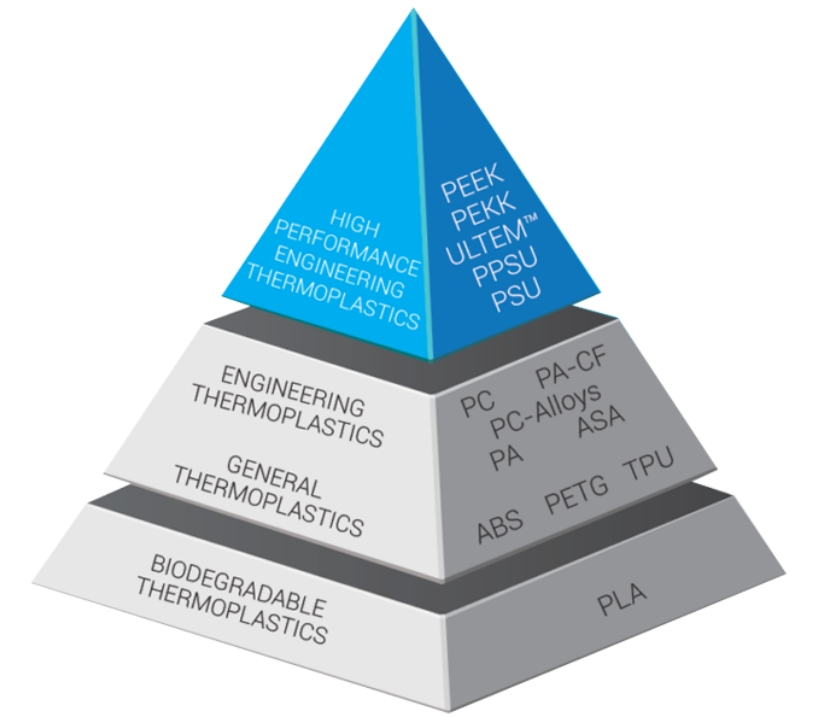
ULTEM (also known as Polyetherimide or PEI) is a family of amorphous thermoplastic. Amorphous meaning it does not have a crystalline structure and therefore has a number of unique mechanical and thermal properties that distinguish it from other families of thermoplastics. This high performance engineering plastic is strong, has high heat resistance and is resistant to many chemicals and also is flame retardant. It was developed by SABIC Innovative Plastics (formerly General Electric Plastics) and is used in a wide variety of industries to design high performance parts and components.
1.1 Different grades and their specific applications of ULTEM.
There are a variety of ULTEM grades that have different mechanical and thermal properties. Amorphous means that the ULTEM has no crystalline structure. As such, the ULTEM materials have unique properties to other amorphous thermoplastic materials. Within the amorphous group of thermoplastic materials, ULTEM in particular has a number of unique characteristics including high strength, heat resistance, and chemical resistance in comparison to the other amorphous materials.
- ULTEM 1000: General purpose grade of ULTEM 1000 (as ULTEM 1000) has a general purpose composition of Polyetherimide, it provides a balanced mechanical, thermal and electrical properties. The mechanical strength of ULTEM 1000 is excellent in terms of tensile and impact strength. ULTEM 1000 also has high stiffness and is resistant to a wide variety of chemicals. In terms of thermal properties, ULTEM 1000 has excellent heat resistance. ULTEM 1000 also has excellent flame retardance (smoke and toxicity). It is therefore a versatile engineering plastic that is suitable for a wide variety of applications.
- ULTEM 1010: ULTEM 1010 has been formulated with increased flow to facilitate processing. ULTEM 1010 has similar mechanical, thermal and electrical properties to ULTEM 1000, but has enhanced moldability and printability.
- ULTEM 2300: This grade of ULTEM is a strong and stiff material, that has been reinforced with glass fibers. It has high mechanical strength and great resistance to creep. ULTEM 2300 is a very stable material and is ideal for applications that are subject to stress and are expected to last a long time.
- ULTEM 9085: This is a Polyetherimide specifically designed for Additive Manufacturing. This material offers high strength-to-weight ratio, along with superior heat resistance. This material has been qualified to the aerospace standards and has been certified by both the FAA and EASA for use in aircraft parts. The other grades of ULTEM that are filled with Carbon Fibers (i.e. ULTEM 1010CG & ULTEM 9085G) are not yet available for 3D Printing. However, ULTEM 1010 and 9085 are available for 3D Printing.
In additional to normal ULTEM grades (ULTEM 1000, 1010, 2300) SABIC also offers several grades that are reinforced with Carbon fibers (CF). These grades are: ULTEM 1010CG and ULTEM 9085G. ULTEM1010 & 9085 are available in 3D Printing. Others not yet.
2. Preparing for ULTEM 3D Printing
2.1 Choosing the right 3D printer for ULTEM
ULTEM printing requires high chamber temperatures, typically above 150°C and up to 200°C or more for larger prints. This usually rules out desktop FDM printers for printing with this material. In choosing a printer, you should be looking for a printer that can hold a minimum of nozzle temperature of 400°C and chamber temperature of 150°C (for smaller prints this can be as low as 70°C 70). Platform temperature must also be controllable at high temperatures.
2.2 Essential printer modifications and upgrades
Check if cables, printed circuit boards, motors, etc. of your printer can get hot and might cause a fire after a longer period of time. There are many postings on the net about printing failures with high temperature materials that caused a fire.
2.3 Bed preparation and adhesion techniques
A glass bed is preferred and printing with a carbon fiber sheet or disposable ULTEM film is recommended. Also the use of an adhesive with PVC content is recommended for the best results.
2.4 Temperature control and considerations
Temperature control is crucial for printing with ULTEM. The chamber temperature and the nozzle temperature need to be monitored. Large differences in temperature can cause printing errors.
3. ULTEM Printing Parameters
– Nozzle, Chamber & bed temperature settings: Nozzle 380°C, Chamber 70-200C380°C ( Small size to big size), bed 130-160°C.
– Layer height and print speed: The layer height for ULTEM1010 is 0.1-0.2mm, for the ULTEM9085 it is better 0.2mm or more, depending on your printer and whether it has a nozzle brush.
– Cooling strategies for optimal print quality: No cooling.
4. Designing for ULTEM: What to consider when designing parts for printing with ULTEM
– Design considerations to maximize strength and performance.
– Support structures and their removal techniques.
– Wall thickness and infill recommendations.
– Overhangs, bridging, and interlocking features.
5. Post-Processing and Finishing
5.1 Support Removal and Surface Prep
Supports have never been easier to remove, thanks to the new easy-off support filament.
• Sanding, polishing, and other finishing techniques
• Chemical smoothing options
There are also a number of chemicals that can be used to smooth a print. These include Limonene, Acetone, N,N-Dimethylformamide (DMF), and Methylene chloride. Most of these have safe ways in which to use them, and unsafe ways. Before using any of the chemicals for smoothing prints it would be wise to read up on the safe use of that chemical, as well as how to use it for print smoothing. As with anything, it is always a good idea to test a small sample first to make sure the chemical will have the desired effect.
6. Applications and Case Studies
ULTEM (Polyetherimide) is a versatile and high-performance thermoplastic material, and it finds applications in various industries. Here are some common applications of ULTEM:
• Aerospace: interior panels, components, brackets, electrical connectors and components, ducting.
• Automotive: In the automotive sector ULTEM parts are known for their high mechanical strength, for their dimensional stability and for their resistance to chemicals and heat. Typical applications are for components in the fuel system, for electrical connectors, for sensor housings and for under-the-hood applications.
• Electrical and Electronics: As one of the few filaments with outstanding electrical insulation, ULTEM is used for a wide array of different electrical and electronic parts and components. Examples include electrical connectors and sockets as well as insulators, coil bobbins, switches and more.
• Medical and Healthcare: The ULTEM thermoplastic material can be used in a wide variety of medical applications and devices. These parts can be made to fit inside of the human body and because of the 3D printing method very complex geometries can be achieved. The material is biocompatible and can be sterilized with high temperatures. In the healthcare field ULTEM parts can be used for surgical instruments and equipment, for medical devices and their housings. In addition to this, ULTEM parts can be used for orthopedic implants as well as for other medical tools and equipment. In summary, the versatile ULTEM parts can be created for many applications within the medical field.
• Consumer Products: There are many other products that will be made from ultem additive printing including, sports equipment, phone cases, laptop components, appliance parts, etc. These items will have very high performance and durability characteristics.
• Industrial Equipment: As a very strong and durable material, ULTEM is used to create industrial components and parts. These parts can be used in harsh environments and will withstand chemicals and high temperatures. This is why ULTEM is used in the creation and manufacturing of: micro pump and valve components. Parts that require connections and fittings. Gaskets. Other industrial components and parts.
Conclusion
ULTEM 3D printing can create very strong and high quality parts and prototypes. By learning about the ULTEM material and the various printing parameters and best practices, you can achieve the best results with your ULTEM 3D prints. This guide will help you to create the best parts and prototypes for your needs.
Thanks for reading our ULTEM 3D printing guide. We hope you found it informative and helpful. If you have any questions about printing with ULTEM then please let us know. We also welcome any experiences or tips you have for printing with the material. We’d love to hear them as we’re always looking for ways to improve our 3D printing. The best way to get better at 3d printing and additive manufacturing with any material is to practice.
[Disclaimer: Always refer to manufacturer guidelines and safety data sheets for specific information and instructions when handling ULTEM or any other materials.]