English
 Deutsch
 Español
 Français
 Italiano
 日本語
日本語 Русский
 中文
中文
3D Printing Surface Finishing: Vapor Smoothing vs. Media Tumbling
- Published October 12 2026 - Updated October 12 2026
Compare how vapor smoothing and media tumbling work, their surface finish results, material compatibility, and key applications to choose the right post-processing method for your 3D-printed parts.
To address the issue of surface roughness in 3D printed parts, vapor smoothing and media tumbling are two noteworthy methods that approach the problem from chemical and mechanical perspectives, respectively.
Vapor smoothing places parts in a special enclosed chamber where controlled vapor will help to soften the surface of the plastic parts. Media Tumbling (Vibratory Tumbling) is the process that uses a vibrating device to repeatedly shuffle the parts and abrasive media together to create contact and friction between them.
The two methods both benefit the surface finish of the 3D printed object, but they have different operating principles, results, and uses. This article outlines the principles, benefits, and drawbacks of both these processes and offers guidance on assessing their appropriateness for particular application requirements.
WHAT IS VAPOR SMOOTHING?
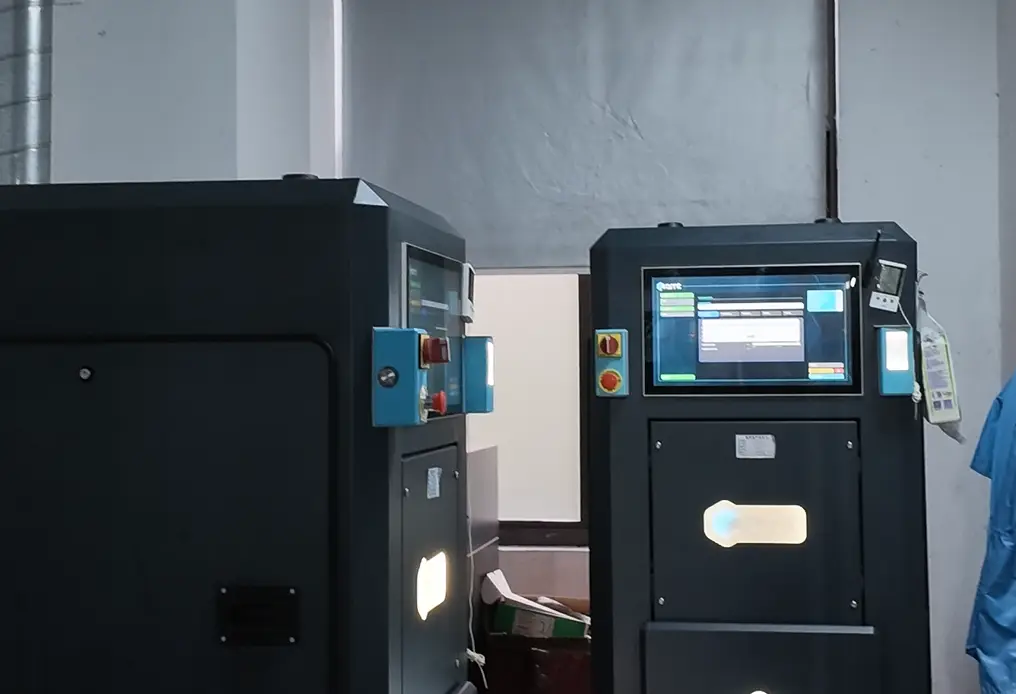
Vapor Smoothing Machines for 3D-Printed Parts
Vapor smoothing machines used to improve the surface finish of compatible 3D-printed plastic parts.
Source: IN3DTEC
Vapor smoothing is a chemical post-processing method that changes the surface topography of plastic parts with the help of solvent vapor. The solvent, in contact with the surface of the polymer, causes reflow and reformation, thus smoothing out microscopic peaks and valleys of the surface. The process smooths the surface and alters its surface structure and, by reducing open porosity, results in a continuous, sealed, and dense final surface.
This is because vapor smoothing goes beyond just removing rough particles from the surface; it changes the material when it touches it, redistributing the surface material. The visible powder particles and inter-particle voids have been greatly reduced after vapor smoothing, as revealed by microscopic analysis of SLS PA12 parts, leading to a more continuous surface. The depth of the treatment and the modification of the surface naturally will vary with the solvent system, polymer properties, and process parameters. Over-treatment may result in edge rounding, dimensional deviations, or surface deformations.
For a more detailed explanation of the process, materials, and applications, read our >>> How to Smooth 3D Prints: A Guide to Chemical Vapor Smoothing
WHAT IS MEDIA TUMBLING?
Media Tumbling is a mechanical post-processing technique that modifies surfaces through the relative motion between abrasive media and the parts. With vibratory tumbling, parts are repeatedly rubbing, abrading, and contacting each other with the media. This action will progressively remove surface projections, resulting in a smooth surface. The mechanism of media tumbling to change part surfaces is very different from the vapor smoothing. The media removal method varies according to the characteristics of the media and part material.
But during the treatment, loss of materials and wear of fine details is possible. Vibratory surface finishing of SLS PA2200 nylon parts has been investigated, and it has been found that it not only alters surface roughness, but also the microstructure and the surface layer hardness.
VAPOR SMOOTHING VS. MEDIA TUMBLING: KEY DIFFERENCES
| Comparison Dimension | Vapor Smoothing | Media Tumbling |
| Compatible Materials | Selected polymers; generally not suitable for metals | Metals and plastics compatible with the media and process |
| Surface Finish | Smooths the surface and may reduce surface porosity | Reduces surface irregularities and can remove some burrs |
| Complex Features | Vapor can reach some areas inaccessible to mechanical media | Recessed or internal areas may receive uneven treatment |
| Dimensional Accuracy | May affect dimensions, edges, and fine details if overprocessed | Material removal may round edges and wear fine features |
| Color Changes | Depends on the material and process conditions | Dark-colored parts may develop visible whitening |
| Painting or Dyeing | Compatibility depends on the material and process | May be suitable depending on the resulting surface condition |
| Relative Cost | Higher | Lower |
| Typical Lead Time | 2–3 days | 1–2 days |
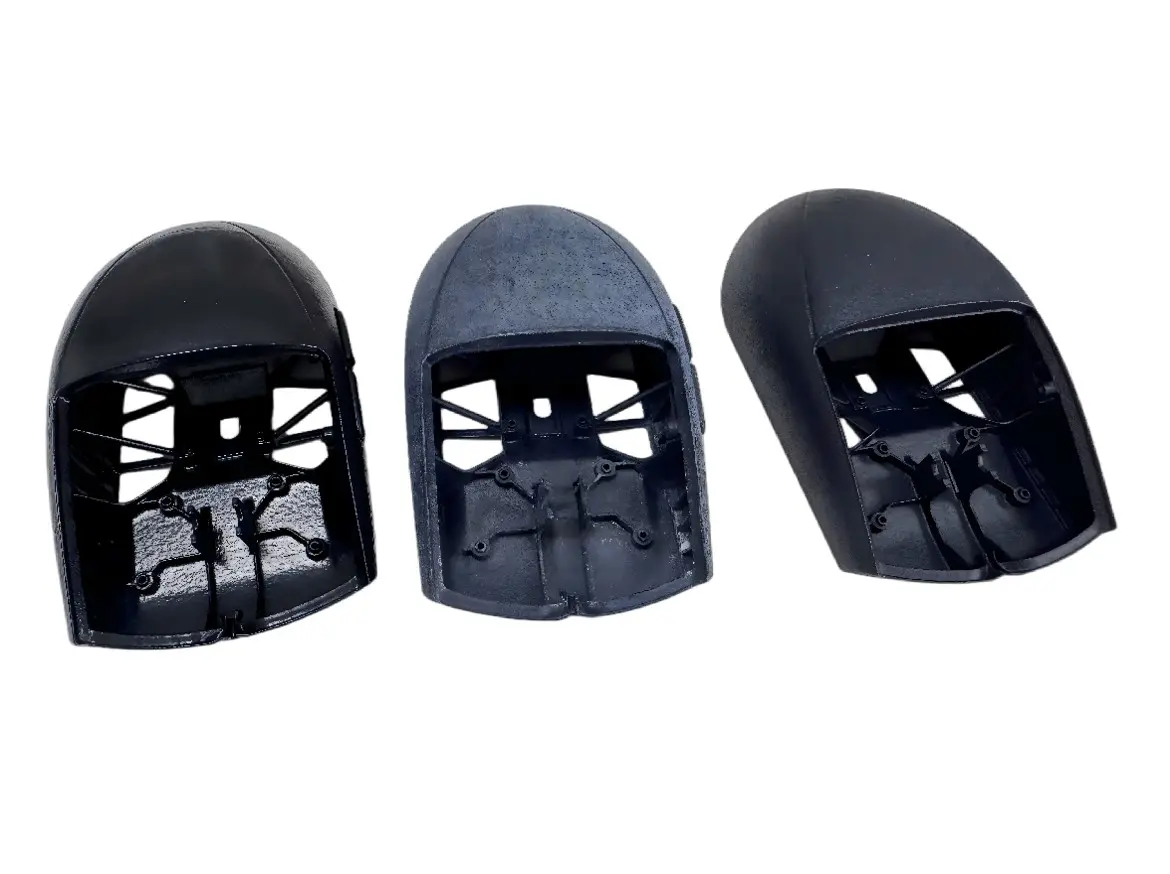
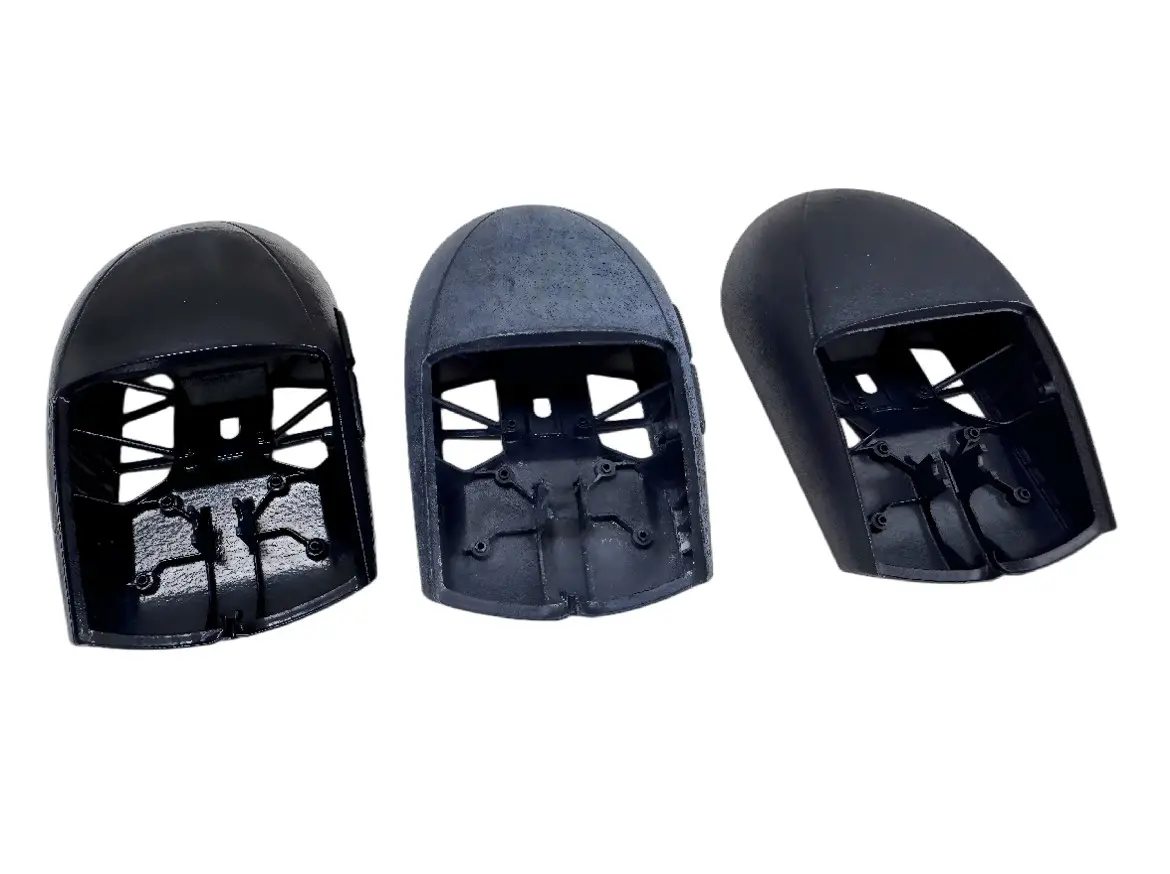
Vapor Smoothing vs. Media Tumbling vs. Raw 3D Prints
Surface finish comparison of raw, vapor-smoothed, and media-tumbled 3D-printed parts.
Source: IN3DTEC
The lead time and relative costs are estimates and subject to change depending on part design, quantity, material, and finish. Both options are batch processing. Contact our team to find out more about IN3DTEC's media tumbling services if mechanical surface finishing is required for your parts and/or a paint or dye job is planned as subsequent processing or if cost is a major factor.
TYPICAL APPLICATIONS OF VAPOR SMOOTHING AND MEDIA TUMBLING
Choose vapor smoothing when:
1. Parts requiring surface sealing: e.g. fluid channels, pipe connectors and some fluid processing parts. One unique benefit of vapor smoothing is that it is better for surface continuity than media tumbling, and should be used over media tumbling.
2. Parts with grooves, internal structures, or complex curved surfaces: Vapor smoothing excels with parts featuring complex curves, grooves, or hard-to-reach areas. Process is possible everywhere the solvent vapors come into contact with it and are able to react, whereas media tumbling is not so easy on these areas, since the media must not only physically reach the surface, but it must also move in relation to it. For parts having fine features or complex internal structure, however, careful consideration should be given to whether the process may impact critical dimensions.
3. Plastic surfaces requiring a smooth, continuous, and uniform appearance: Examples include product housings, equipment covers, and end-use plastic parts where aesthetics are important. Vapor-smoothed parts often exhibit a distinct gloss, whereas media tumbling typically produces a uniform matte finish.
Choose media tumbling if your parts:
1. Mainly need mechanical surface modification (such as better surface texture, or the removal of minor burrs), but not lower open porosity or seal a surface layer..
2. Are moving parts or functional components needing to be assembled, such as print hinges, snap-fits and parts of the assembly involving relative motion? Smoothing out surfaces creates better friction properties in the contact points that results in better moving or assembly properties.
3. Needs surface preparation for further painting or coating: Media tumbling will give a consistent outer surface for further processing painting or coating. However, take note that the surface created by the vapor smoothing process might influence the adhesion of the coating so care must be taken.
4. Demand cost-effective batch processing with parts that can be processed with appropriate geometry, without the need for any special surface-sealing effect from the abrasive media: In the case of batches of parts that can be processed with enough surface contact with the abrasive media, media tumbling is an appropriate and cost-effective batch processing method. If the batch size and process conditions are suitable, it can be processed in a single cycle, so that the cost of post-processing per unit can be reduced. However, if the main application is facing or smoothing of intricate inside surfaces, then mass finishing (tumbling) cannot be chosen because of the lower cost of the process.
Vapor smoothing and media tumbling are for different surface finishing requirements. A broad evaluation of material compatibility, part geometry, surface characteristics, dimensional tolerances, and downstream processing requirements are all important factors to consider when choosing a process. For this process, please consult with IN3DTEC to address the material, structure, and surface properties of your part and determine if this process is right for you.