English
 Deutsch
 Español
 Français
 Italiano
 日本語
日本語 Русский
 中文
中文
How to Smooth 3D Prints: A Guide to Chemical Vapor Smoothing
- Published October 10 2026 - Updated October 10 2026
Learn how chemical vapor smoothing works, which 3D printing materials are compatible, and how to achieve a smoother surface finish on 3D-printed parts.
Although 3D printing has transformed manufacturing, the surface finish of the raw 3D printed parts may not be suitable for end-use. Chemical vapor smoothing is one way of smoothing 3D prints to improve the surface quality. It is a post-processing method that applies a solvent vapor under controlled conditions to the surface of a polymer and helps smooth the surface and reduce granular textures and layer lines. But some 3D printing materials don't work with this method, and a host of factors can interact with all interactions to affect the outcome of the prints. This guide will explain what vapor smoothing is, its major benefits, and how and which material suits up and how the process affects the smoothing results. It also provides engineers with an overview of the important considerations to take into account when selecting a 3D-printed parts finishing solution.
WHAT IS VAPOR SMOOTHING?
Vapor smoothing is a controlled chemical surface finishing method that softens the top layer of a polymer part. When exposed to controlled solvent vapor, the polymer surface happens to reflow and reform, resulting in microscopic peaks and valleys partially leveling out. It can become a more continuous surface layer and effectively reduce the structural and surface porosity. After the solvent evaporates, the surface re-hardens; finally, there's a characteristic sheen with a smoother finish, depending on the material and process conditions.
As an industrial process, vapor smoothing allows parameters to be adjusted based on different parts’ material, geometry, and target surface finish. This means the vapor smoothing process has consistency and repeatability, making it a suitable smoothing method for both rapid prototyping and low-volume production. Under suitable conditions, the resulting finish can even achieve a surface finish quality similar to that of injection-molded parts.
WHAT ARE THE ADVANTAGES OF VAPOR SMOOTHING?
- Low surface roughness: The test shows that the surface roughness of the material can be lowered by 72% to 81% by this process.
- More uniform and continuous surface appearance: The surface of a 3D-printed part shows granular textures or visible layer lines. While the look will vary based on the 3D printing process, material, and part geometry, vapor smoothing can help close the visual difference between 3D-printed and injection-molded surfaces.
- Liquid penetration of the surface structure: As-printed parts can have surface structure that enables penetration of the liquid. Vapor smoothing can decrease surface porosity to increase the resistance to liquid penetration under certain materials and processing parameters. The weight gain of the PA12 specimen after 24 hours in diesel decreased from 0.28% to 0.02% after vapor smoothing, as shown in the tests. Under the same test conditions, the weight gain of PA11 specimens decreased from 0.29% to 0.01%.
- Vapor smoothing can enhance elongation at break in some materials by changing the surface layer and by minimizing some of the surface defects. Elongation at Break was found to rise from 40% to 49% for Nylon 11 and from 4% to 6% for Nylon 12 GF, and even as high as 200% for some materials.
- Better surface finish on complex geometries: The vapor smoothing process does not use the direct contact of the mechanical tooling, so it can be used to achieve a better surface finish in difficult-to-access areas on complex geometries as compared with conventional mechanical finishing processes. This can be beneficial for components that have intricate internal structures like pipes and tubes.
- Smoothing creates smoother, less porous surfaces that can minimize surface irregularities where contaminants can get trapped, allowing parts to be more easily cleaned. This can be advantageous in applications where hygiene is important, such as food contact and healthcare applications, if the material and finished part comply with the respective requirements.
Noted: These benefits have been confirmed by research under certain material and processing conditions, but they may vary depending on the type of material used, the processing conditions, the geometry of the parts, and the printing parameters. The surface finish, dimensional accuracy, and functional requirements should all be considered for each project. IN3DTEC can help determine material compatibility and provide a choice of a suitable surface finishing process.
Data sources: Enhancing the Surface Quality of SLS 3D Printed Parts With Vapor Smoothing: A Collaborative Study by Formlabs and AMT
WHAT ARE THE 3D PRINTING MATERIALS THAT CAN BE VAPOR SMOOTHED?
Vapor smoothing is not suitable for all 3D printing polymers. Material suitability will be determined by the compatibility of the polymer and the medium used to process it and the ability to fulfill the surface-finish and dimensional standards for the part following treatment.
1. Why Can Some Plastics Be Vapor Smoothed?
Vapor smoothing uses a processing medium that is capable of interacting with the polymer surface (in this case solvent vapor). The nature of the polymer and the crystallinity and the formulation of the material can result in different responses to the processing media. Thus, different materials, even from the same polymer family, can have different responses, depending on the differences in additives, fillers, and formulations.
2. What is the effect of fiber fillers?
The inclusion of CF and GF in engineering polymers is a frequent practice for enhancing stiffness, mechanical attributes, and dimensional stability. In fiber-reinforced materials, the vapor smoothing tends to affect the polymer matrix but not the reinforcing fibers. Hence, the extent of the surface improvement varies, partly according to the distribution and exposure of the fibers at the surface.
In determining the suitability of fiber-reinforced materials, remember the following:
- Surface roughness, which is mostly due to irregularities of the polymer matrix, can produce smoother surfaces by vapor smoothing.
- Fiber distribution/exposure: If fibers are present at the surface or not distributed there, the effectiveness of the treatment may be reduced.
- Surface-finish requirements for the final application: If the part will not be subjected to a high-quality surface finish, then the added treatment may not be of much practical value.
Evaluation of these materials should be based on the particular material formulation and part requirements, rather than the material designation (e.g., GF or CF) alone, because the formulation can have an impact on the results.
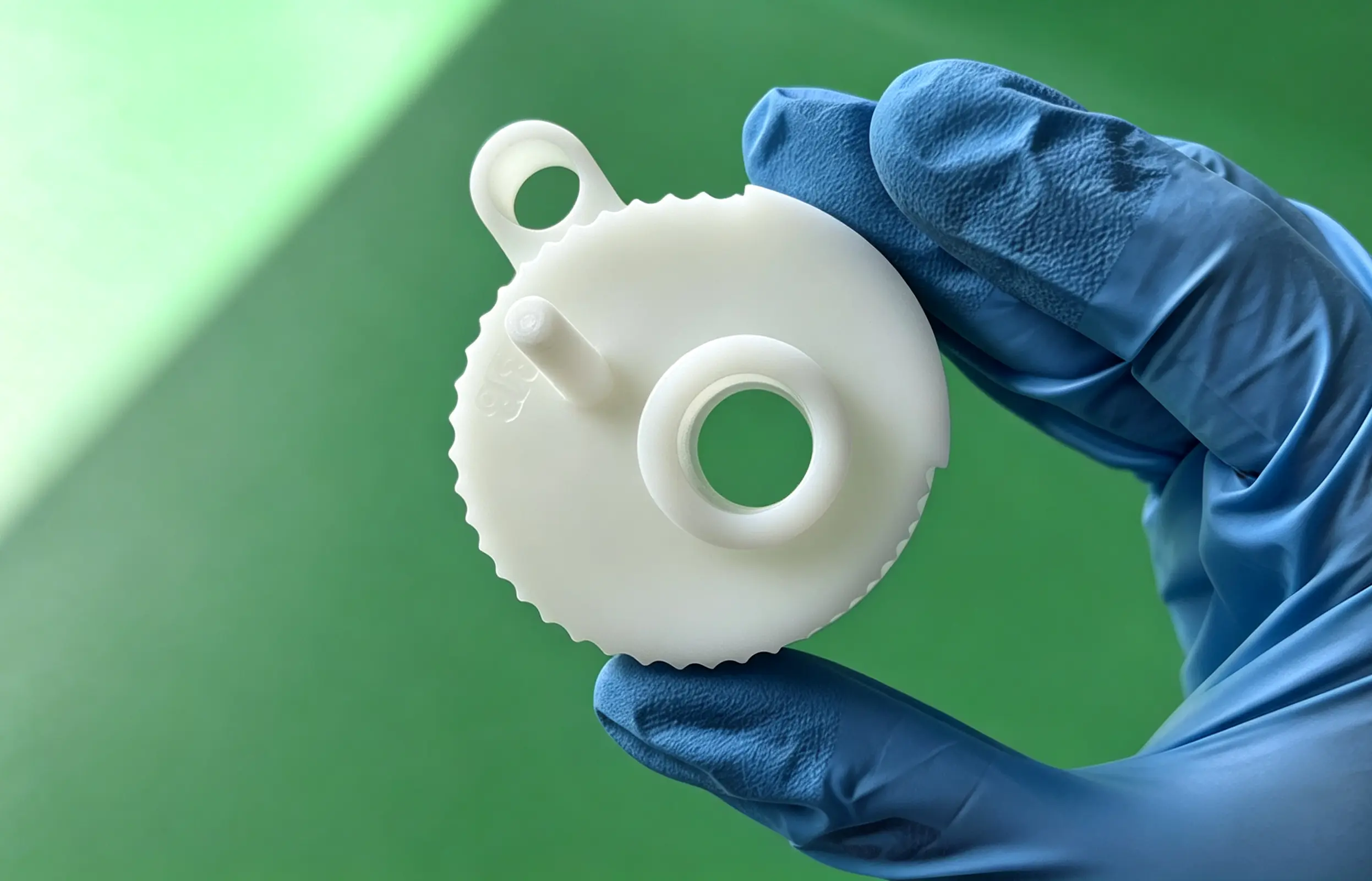
Smooth Surface Finish on a 3D-Printed Plastic Part
Caption: A 3D-printed plastic component with a smooth, matte surface finish.
Source: IN3DTEC
3. Materials Offered by IN3DTEC
There are currently SLS, MJF, and FDM materials available from IN3DTEC, as shown in the following table.
| SLS | PA12, PA12+CF, PA12+GF, PA11, PA6+GF, PA6+CF |
| MJF | PA12, PA12+GF, PA11 |
| FDM | PLA, ABS, ASA |
See the IN3DTEC Chemical Vapor Smoothing Service Page for a list of the materials available and which materials are eligible for direct online ordering and which materials need to be engineered. Our team can also help you determine the material compatibility, surface-finish needs, and process options to determine which one is right for your project.
HOW TO CHOOSE THE RIGHT VAPOR SMOOTHING SOLUTION?
The selection of the correct surface finishing process is dictated by material compatibility, desired surface finish, part geometry, tolerances, functionality, and cost. The following design guidelines are recommended by IN3DTEC for parts being processed with VaporFuse:
- Wall thickness: At least 0.8 mm; keep the thickness as uniform as possible.
- Hole diameter: No less than 1.0 mm; make it easy to remove the powder from the inside of the hole.
- Allowance for assembly: At least 0.25 mm per side.
- Colour: Black is recommended, with small black spots developing on white parts.
- Inserts: Sizes the holes in the installation 0.2–0.3 mm less than the outside diameter of the insert.
- Hanging points: Include points for suspending parts inside the processing container.
These are general recommendations and can be different depending on part design and processing conditions.
IN3DTEC provides chemical vapor smoothing services and can help determine the need for your project. Check our Chemical Smoothing Service Page or reach out to our team to explore material compatibility and appropriate processes for your parts.
WHAT ARE THE COMMON USES OF CHEMICAL VAPOR SMOOTHING?
A variety of plastic parts requiring surface smoothness, appearance, or porosity are treated by vapor smoothing. Common applications are:
- Medical equipment and products for healthcare applications: These components can be required to have high dimensional accuracy, durability, and biocompatibility. The smoothing effect of vapors can give a smoother surface, with less surface porosity, which might help to clean and provide better user comfort. Specific medical applications also depend on the right material certifications, validated cleaning/disinfection processes, and the compliance with applicable medical regulations.
- In the wearables industry, parts should be lightweight, durable, comfortable, and aesthetically pleasing. Vapor smoothing may help to smooth the surface and enhance tactile qualities, which can be beneficial for parts that come into contact with the skin or have very particular looks.
- Food-related equipment and components: Often high standards are required for cleanability, surface quality, and liquid penetration resistance. Under appropriate conditions, vapor smoothing can help to reduce surface irregularities and porosity, which can aid in cleaning. The final product, however, shall undergo a separate assessment of the applicable food contact and food hygiene requirements.
- Parts with complex geometries: Vapor smoothing can offer advantages for parts featuring complex geometries, internal channels, or surfaces that are difficult to reach through mechanical sanding. For parts that have thin walls, sharp edges, or close tolerances, however, the potential for dimension and fine feature change needs to be carefully considered.