English
 Deutsch
 Español
 Français
 Italiano
 日本語
日本語 Русский
 中文
中文
HP MJF Surface Treatment Simplify explained
- Published November 07 2025 - Updated October 19 2026
Learn about HP MJF surface treatments including vaporfuse smoothing, dyeing, bead blasting, and polishing. Understand how each post-processing method improves strength, appearance, and performance.
This article helps you choose a suitable surface treatment by introducing the post-processing process of MJF Multi Jet Fusion 3D printing. There are five common MJF printing surface treatment processes.
- MJF prints with natural color
- MJF prints with dyed black
- MJF prints with vaporfuse smoothing
- MJF prints with graphite blasting
- MJF Prints with polishing & painting
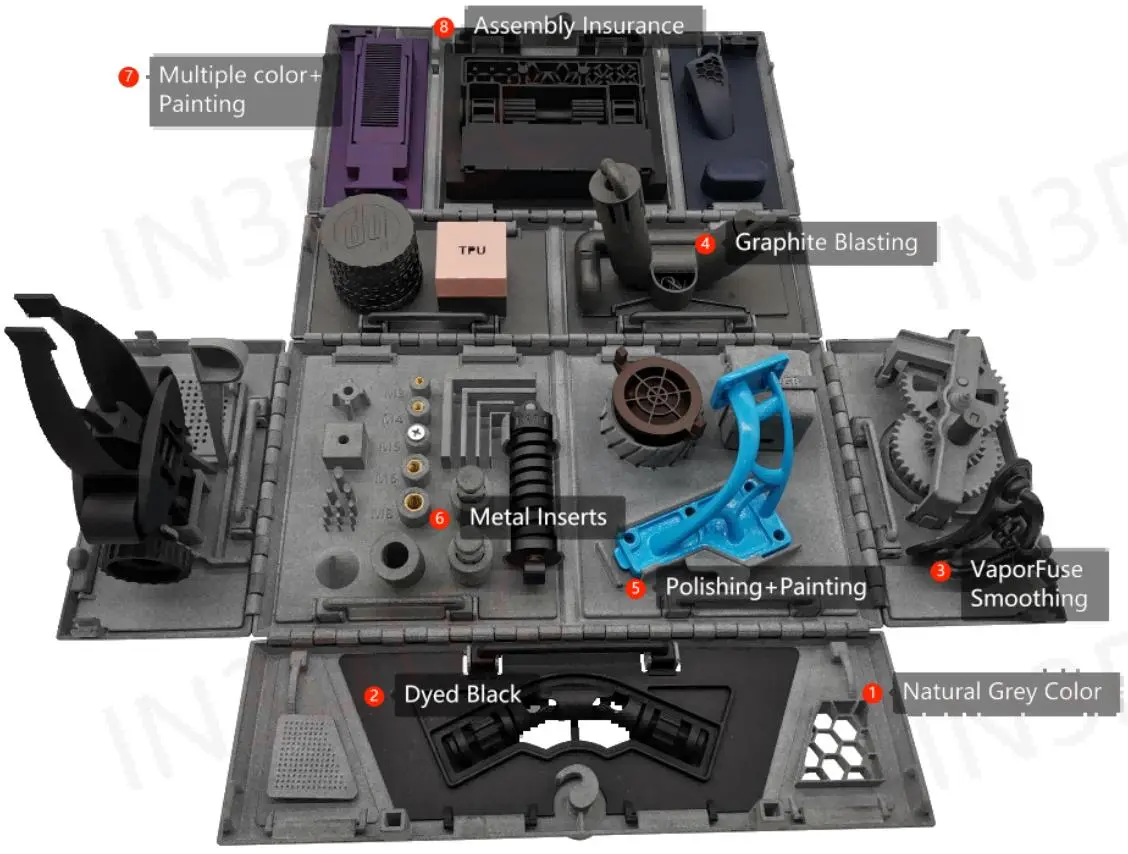
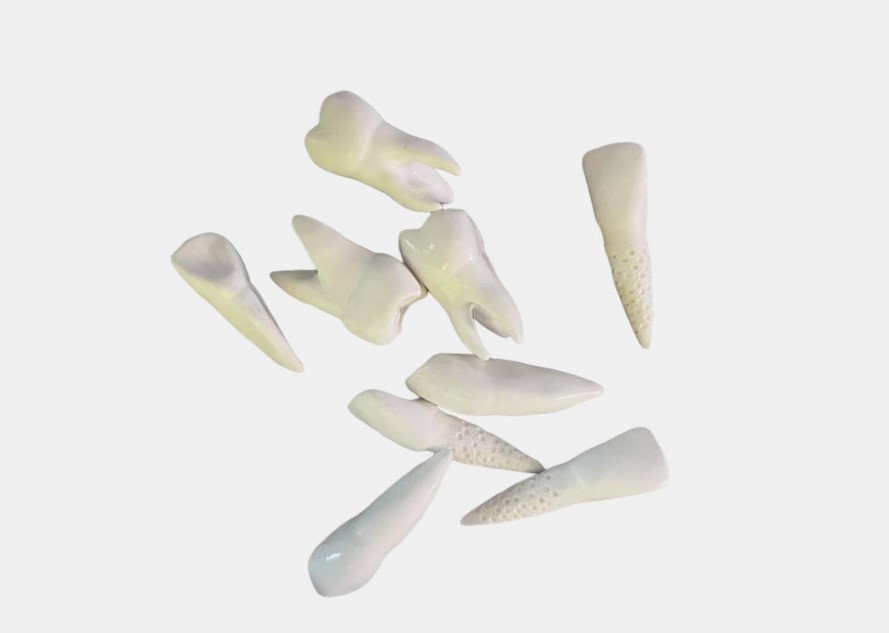
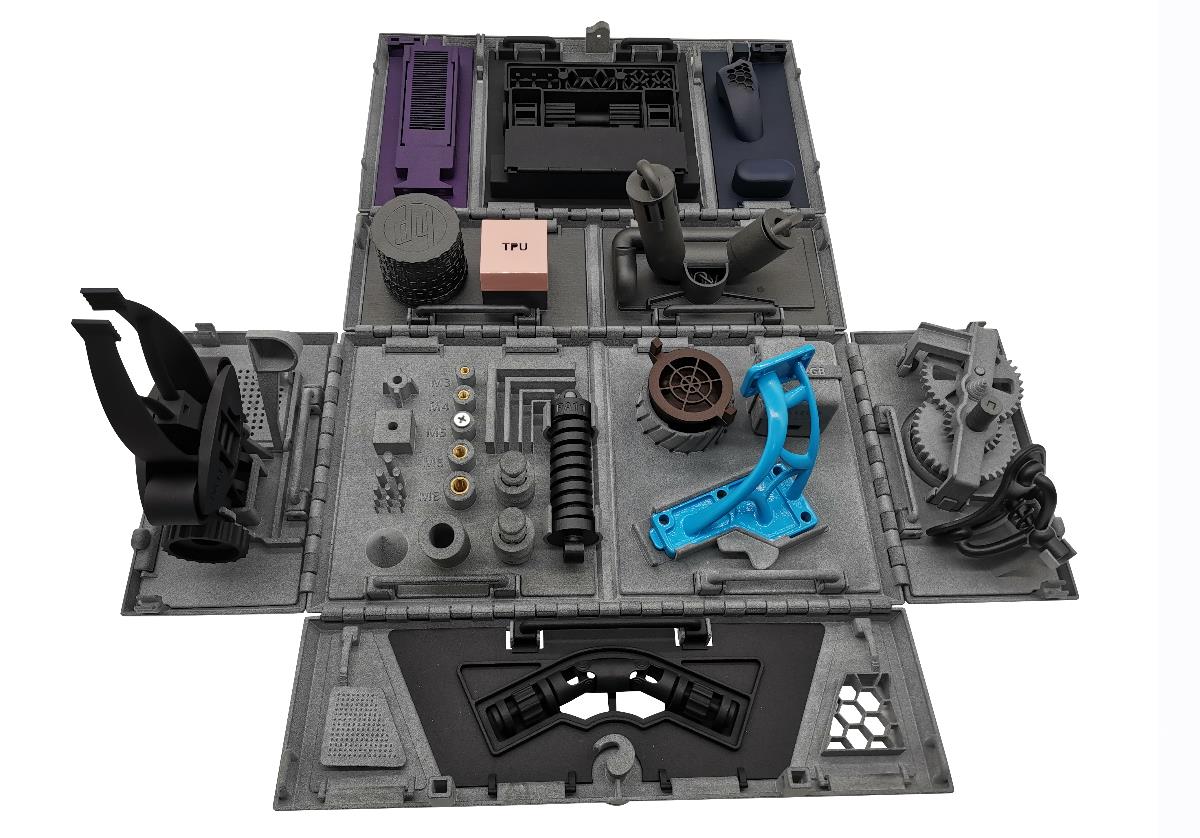
HP Multi Jet Fusion (MJF) 3D printed components demonstrating different post-processing options, including natural gray, black dyeing, VaporFuse smoothing, graphite blasting, polishing, painting, and metal insert assembly.
1. MJF PRINTS WITH NATURAL COLOR: UNDERSTANDING THE "RAW" FINISH
The natural color of MJF 3D printing is gray, but it is not pure gray, some white powder will be seen on the surface. Why is there a slightly white powder? Did you know that the natural color of its material is white? This has to start with the principle of its craft.
The Science Behind the Color: What is MJF 3D Printing?
HP Multi Jet Fusion (MJF) technology is a powder-bed fusion 3D printing technology that allows for the production of accurate, functional prototypes and final parts.
The Multi-Agent Printing Process
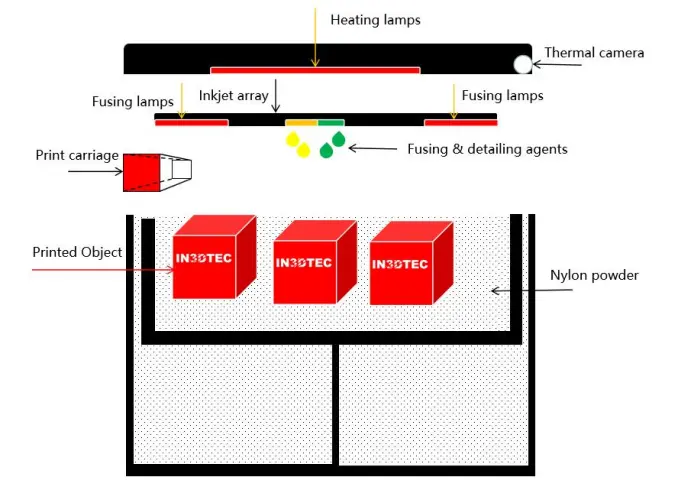
The HP Multi Jet Fusion 3D printing process begins with a thin layer of uniformly pre-heated polymer powder particles that is spread across the build platform.
Then, to achieve part quality at a high speed and produce truly functional parts, HP MJF printing technology uses the HP multi-agent printing process. HP’s in-depth knowledge of 2D printing solutions and the capability of HP’s proprietary architecture makes it possible to print millions of drops per second.
Fusing Agents vs. Detailing Agents
HP Multi Jet Fusion’s multi-agent printing process can control the exact amount of each agent that is deposited in each voxel of the intended part. This printing process involves two different types of agents that are applied across the build platform: fusing agents and detailing agents.
- A fusing agent is applied where the particles are meant to fuse together in the powder in order to create the corresponding part cross section, leaving the rest of the powder unaltered.
- A detailing agent is applied to the edges of the part in order to modify the fusing process and create fine detail and smooth surfaces.
Next, an energy source passes over the build platform, provoking a reaction between the agents and the material that causes the material to selectively fuse to form a complete layer, thus resulting in production throughput, material density similar to common Injection Molded plastics, and consistent mechanical properties in all directions.The process is then repeated until a completely functional part has been formed.
Note on Color: Since the fusing agent is black and the base powder is white, the result is the signature MJF gray. The interior of the part remains solid black.
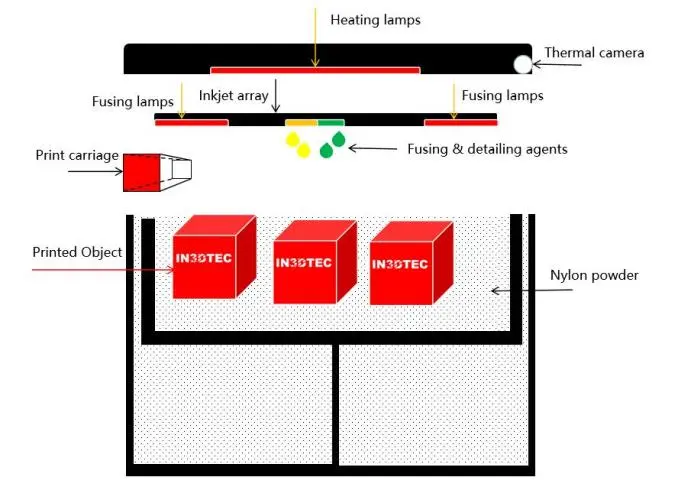
Illustration of the HP Multi Jet Fusion (MJF) 3D printing process, showing how heating lamps, fusing and detailing agents, and nylon powder work together to produce solid parts layer by layer.
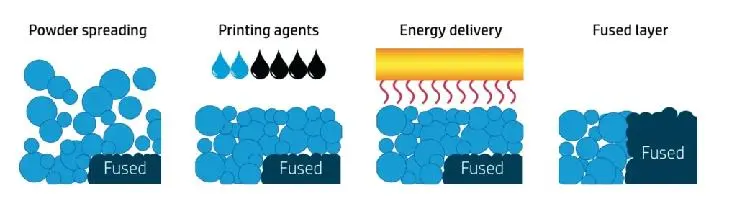
HP Multi Jet Fusion (MJF) process illustrated in four stages: powder spreading, printing agent application, energy delivery, and selective powder fusion to build solid 3D printed parts.
2. AESTHETIC UPGRADES: MJF PRINTS WITH DYED BLACK
This is easier to understand, so we don’t need to explain too much.
3. PERFORMANCE ENHANCEMENT: MJF WITH VAPORFUSE SMOOTHING
This is a good choice if you want to increase the strength of your part while improving the smoothness and water resistance of the surface.
Design Considerations for Vaporfuse
Vaporfuse smoothing is to hang the parts first, and then place them in a chamber filled with chemical solvents. Therefore, it is best to design parts that allow hanging parts, otherwise they cannot be completely fumigated.Because chemical solvents are fluid so it is also suitable for container type parts.
What is vaporfuse smoothing? Please click HERE to learn more about it.
4. INDUSTRIAL FINISHES: MJF WITH GRAPHITE BLASTING
What is graphite blasting?
Graphite sandblasting uses the same process as bead blasting, but the purpose is to make the parts have a uniform metal appearance, and project glass bead and graphite on the parts. it results a dark grey surface.
Functional Benefits and Limitations
This can also reduce friction between moving components, but it is not recommended to use it for frequently handled because it will slightly fade.
5. PREMIUM CUSTOMIZATION: POLISHING + PAINTING
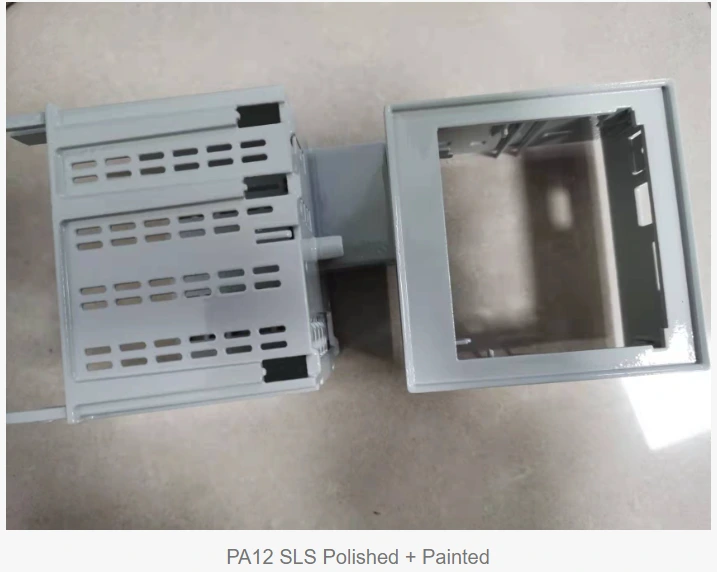
There are more than 20+ colors are avaible from IN3DTEC polishing + painting services.In additional there are some others surface treatment of MJF 3D Prints, such as color dyeing, bead blasting, etc.
IN3DTEC is company who can offer most of the above surface treatment. Contact us or get a quote online in seconds.