English
 Deutsch
 Español
 Français
 Italiano
 日本語
日本語 Русский
 中文
中文
Wall Thickness: How to Design Wall Thickness for 3D Printing
- Published April 22 2026 - Updated October 14 2026
Let’s explore the different ways to design wall thickness for 3D Printing.
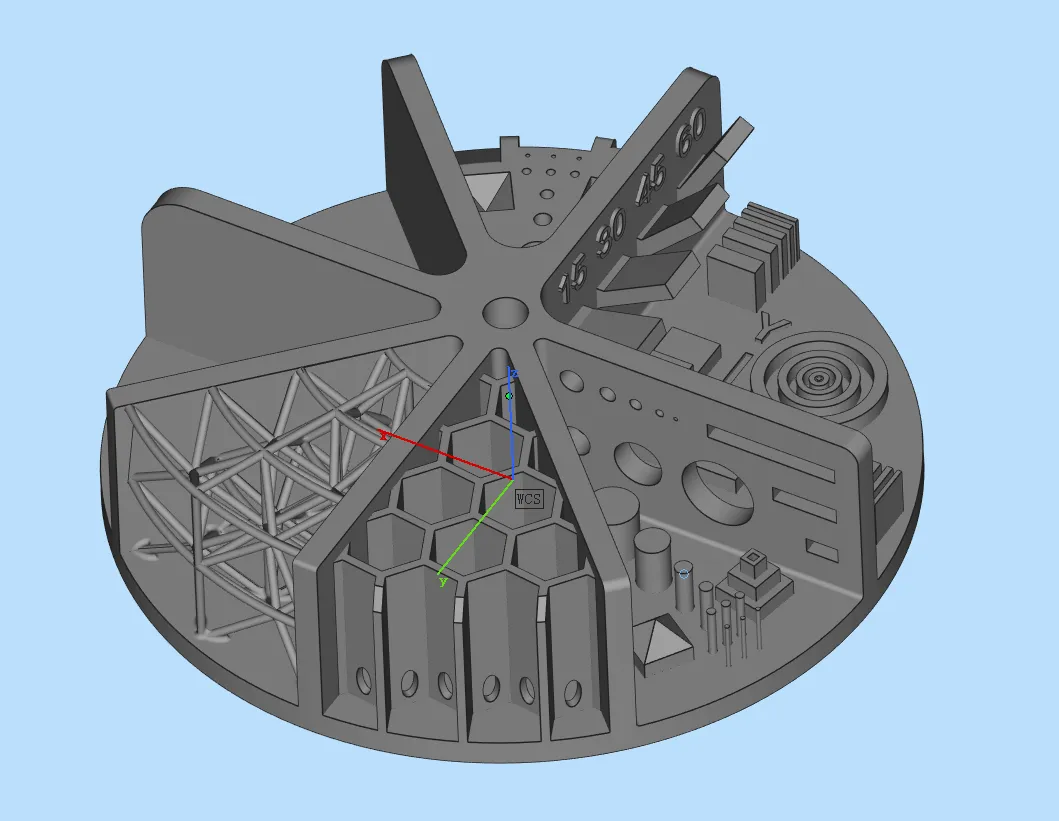
Wall thickness is one of the key factors determining the success of 3D printing. Different 3D printing technologies have different requirements for wall thickness, and the thickness of the walls also has a decisive impact on deformation, dimensional accuracy and surface roughness.
Combined over 10 years of printing experience from IN3DTEC engineers, this blog will help you choose the most suitable wall thickness for your projects.
1. QUICK REFERENCE
| Process | Recommended Min Wall Thickness | Min Feature Size | Key Notes |
| FDM | 1.2 mm | 0.8 mm | Wall thickness should be ≥2× nozzle diameter; too thin leads to weak parts |
| SLA | 1.0 mm | 0.5 mm | Thin walls are fragile during post-processing; printable ≠ manufacturable |
| SLS | 1.5 mm | 0.8 mm | High-temperature process (~200°C); thin walls may warp during cooling |
| MJF | 1.2 mm | 0.6 mm | More stable than SLS, but sufficient thickness is still required |
| SLM/DMLS | 1.2 mm | 0.5 mm | Requires supports; internal stress and post-processing can deform thin walls |
| Binder Jetting | 1.0 mm | 0.5 mm | — |
Note:
The minimum wall thickness usually refers to the overall wall thickness of the part. The minimum detail refers to certain minimum detail features in specific areas of the part.
2. WALL THICKNESS GUIDELINES BY TECHNOLOGY
2.1 FDM Technology 3D Printing Wall Thickness
The printing principle behind Fusion Deposition Modeling FDM 3D Printing is melting filament of a fixed diameter through nozzles of varying diameters, and then building up the object layer by layer. Common filament diameters are 1.75 mm and 2.85 mm. We recommend choosing 1.75 mm filament, because it is more suitable for mainstream 3D printer models. When selecting an extrusion nozzle, common diameters include 0.2 mm, 0.4 mm, 0.6 mm and 1.0 mm etc.
It is easy to understand that the smaller the nozzle diameter, the thinner the wall thickness that can be achieved. For example:
- When selecting a 0.2 mm nozzle, the minimum wall thickness achievable is 0.4 mm.
- With a 0.4 mm nozzle, the minimum wall thickness achievable is 0.8 mm.
A wall thickness that is half the nozzle diameter is the parameter we recommend. However, if the prototype has strength requirements, the recommended wall thickness for FDM should ideally be no less than 1.0 mm or 1.2 mm.
2.2 SLA 3D Printing Wall Thickness
The principle behind SLA Stereolithography 3D printing is using the light to cure liquid resin. The final wall thickness is closely linked to the spot diameter. Common industrial equipment typically permits a minimum wall thickness of no less than 1 mm. However, fine details on a part measuring no less than 0.5 mm can still be printed.
However, it should be noted that in the actual manufacturing process, post-processing steps such as cleaning the printed parts with alcohol to remove residual resin, sanding support points and sandblasting are required. Therefore, even if a wall thickness of 1 mm can be printed, fine details are often damaged during subsequent processing, particularly during stages involving manual handling.
2.3 SLS 3D Printing Wall Thickness
The principle behind SLS Selective Laser Sintering 3D Printing is using a carbon dioxide or fibre laser to melt powdered material at high temperatures, with the final shape formed by stacking layers. As this process does not require support structures, the complexity of the design is significantly reduced. However, during the SLS printing process, the temperature inside the printer’s chamber typically exceeds 200 degrees. If an object has large areas of thin-walled sections, it is highly susceptible to deformation during cooling due to internal stresses. Consequently, the degree of deformation is a key consideration in SLS printing.
We recommend that a minimum wall thickness of no less than 1.5 mm is a safe figure to ensure that no deformation occurs during the printing process. Whilst this does not mean that details less than 1.5 mm cannot be produced, the minimum detail size should still not be less than 0.8 mm.
2.4 MJF 3D Printing Wall Thickness
The principle behind MJF Multi Jet Fusion 3D printing is mixing a binder with a co-solvent to create inter-layer bonding, with the part being built up layer by layer. MJF Multi Jet Fusion technology is like SLS printing, but it has relatively less stringent requirements regarding wall thickness.
Our recommendation is that wall thickness should still be maintained at 1.2 mm or above, and the minimum detail size should not be less than 0.6 mm.
2.5 SLM / DMLS Metal 3D Printing Wall Thickness
SLM Selective Laser Melting, also known as DMLS Direct Metal Laser Sintering, works by using a laser to melt metal powder layer by layer, which are then stacked to form the final shape. When designing wall thicknesses for SLM 3D printing process, the impact of support structures must be fully taken into account. Like FDM, SLM printing process requires the addition of support structures during the printing process. This is to prevent the formed parts from being affected by strong internal stresses, which could cause positional shifts and ultimately lead to misalignment between layers. Consequently, extensive polishing is required afterwards to remove the support points and make a flat surface.
Our recommendation is to maintain a wall thickness of at least 1.2 mm, with a minimum detail size of no less than 0.5 mm. Naturally, for parts requiring high levels of sealing and airtightness, a wall thickness of no less than 1.5 mm is advised.
2.6 Additional Technologies
Other additive manufacturing technologies include Binder Jetting, DLP, LCD and Sand 3D Printing. Please feel free to contact IN3DTEC for further expert advice to help you avoid unnecessary setbacks when designing your products.
Wall thickness is only one part of designing a model for successful 3D printing.
For a broader look at the key design considerations, including wall thickness, overhangs, and tolerances, see our guide to Design for 3D Printing: Wall Thickness, Overhangs, and Tolerances.