English
 Deutsch
 Español
 Français
 Italiano
 日本語
日本語 Русский
 中文
中文
Exploring the Different Types of 3D Scanners: Which One is Right for You?
- Published November 06 2025 - Updated September 10 2026
A strategic comparison of scanning technologies to help you select the ideal precision tool for your project.
3D scanners are powerful tools that can capture the physical geometry of objects and transform it into precise digital models. From industrial manufacturing to medical imaging, these devices play an important function in multiple various industries. However, with the wide variety of 3D scanners available on the market, choosing the right model can often be confusing.
In this blog, we will do a complete examination of the different types of 3D scanners, their working principles, and ideal application scenarios to help you determine which one best suits your needs.
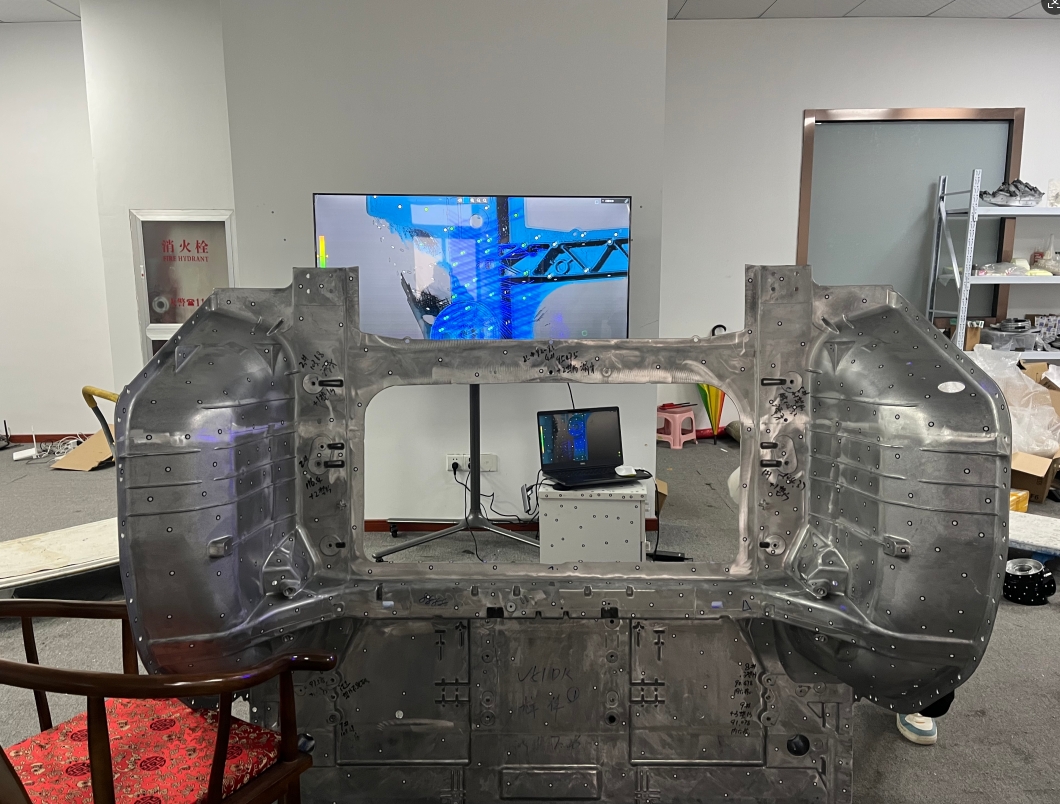
1. STRUCTURED LIGHT SCANNERS
Structured light 3D scanner projects a grating pattern (usually stripes) onto an object, and their cameras capture how this pattern deforms on the object's surface. Their signal receiving software then calculates the three-dimensional geometry based on this.
This scanner offers high precision, high resolution, and fast scanning speed. It is a non-contact scanner, making it safe for delicate or fragile objects.
It can be applied in quality control in manufacturing, reverse engineering, and medical imaging (e.g., prostheses).
However, it is sensitive to lighting conditions and has a limited scanning range, so it is good for small to medium-sized objects.
2. LASER SCANNERS
Laser 3D scanner uses laser beams to capture surface information of objects. By scanning the surface of an object with a laser line or spot, the sensor records and reflects data to generate a 3D model.
This scanner offers high precision, capturing fine details and performing well on reflective surfaces.
It can be used for inspecting automotive and aerospace components, preserving cultural heritage, and in industrial design and prototyping.
However, compared to structured light scanners, it is slower and potentially more expensive.
3. PHOTOGRAMMETRY
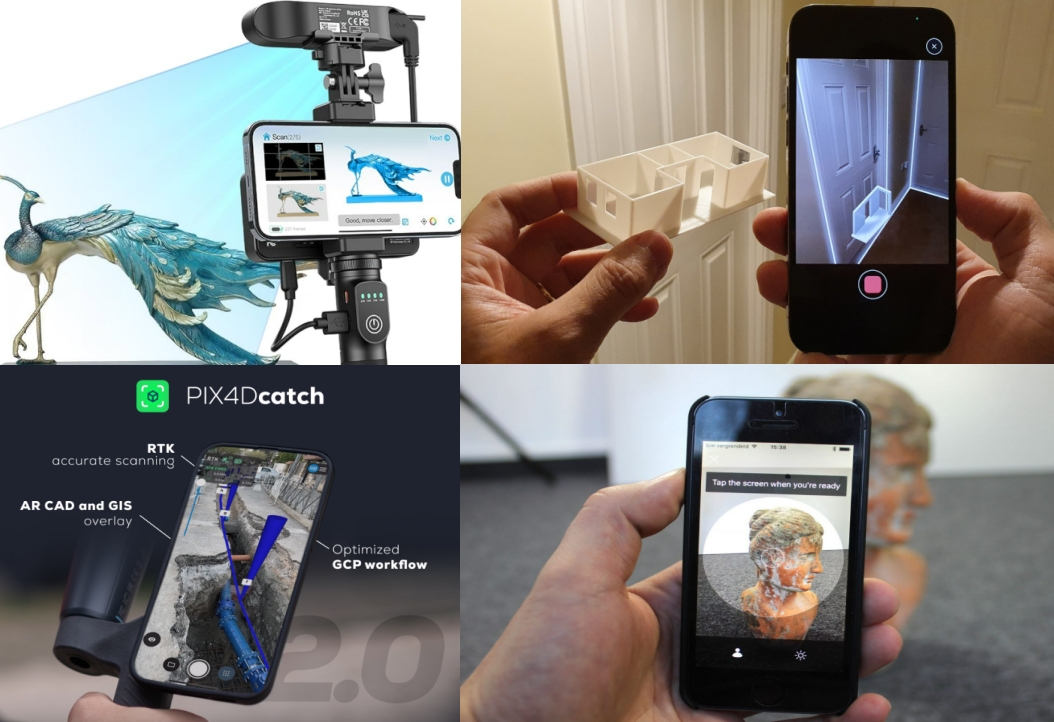
Photogrammetry is a 3D scan method that takes multiple photographs of an object from different angles. Software then analyzes these photographs to generate a 3D model.
This method is highly portable, inexpensive (using a standard camera), and great for large objects and environments. It can be applied in archaeology and architecture, game and film asset creation, and surveying.
However, the processing using this method is time-consuming and requires good lighting conditions and photographic skills to achieve optimal results. Compared to laser or structured light scanners, its scanning accuracy is lower.
4. TIME-OF-FLIGHT (TOF) SCANNERS
A Time-of-Flight (TOF) 3D scanner works by measuring the time it takes for a laser or light pulse to travel to and from an object. This data is used to calculate distances and generate 3D models.
This scanner can quickly scan large areas, it is great for large-scale scanning (such as buildings and landscapes). Therefore, it is primarily used in architecture and construction, film and video game scene creation, and infrastructure planning.
However, this scanner has lower resolution for fine details and limited accuracy at close distance
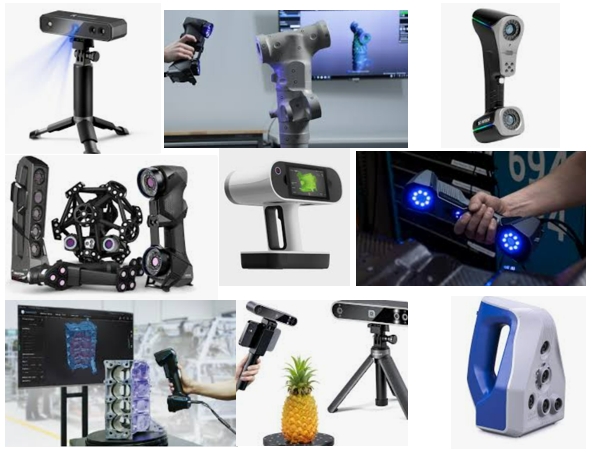
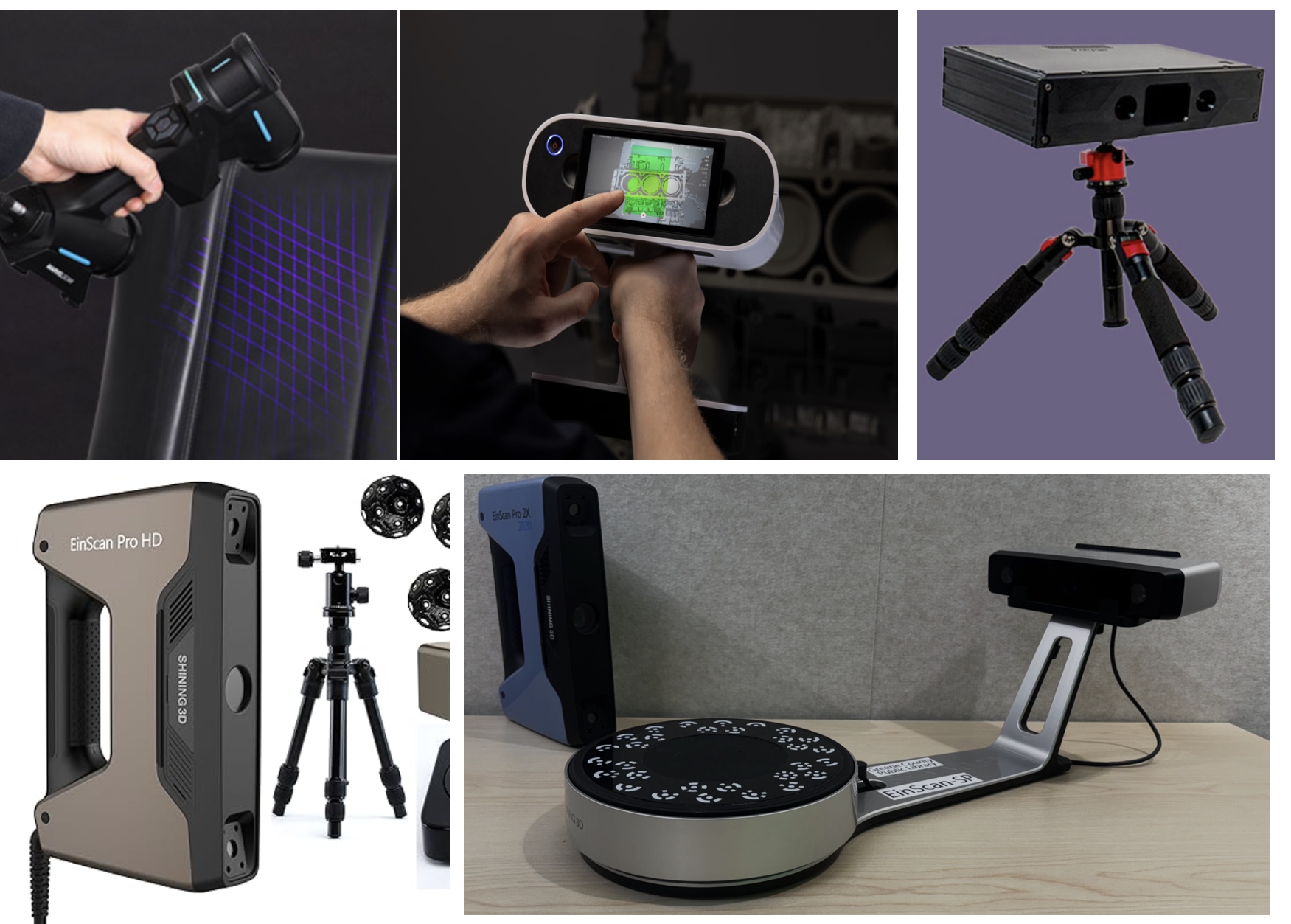
5. HANDHELD 3D SCANNERS
A handheld 3D scanner is a portable device that uses technologies such as structured light or lasers. It can be used to manually scan objects and environments.
This scanner is highly portable and good for scanning objects of various sizes on-site. It can be applied in the automotive and aerospace industries, forensic identification and crime scene investigation, as well as product design and prototyping.
However, consistent results depend on the operator's skill. Accuracy may differ compared to fixed scanners.
6. DESKTOP 3D SCANNERS
Desktop 3D scanners are compact devices designed specifically for scanning small objects. They typically use structured light or laser technology.
These scanners are easy to use and offer high scanning accuracy and rich detail, making them good for scanning small, structurally complex objects.
They can be used in jewelry and small product design, dental and medical modeling, education, and research. However, they can only scan small objects and are not as portable as handheld scanners.
7. CT SCANNERS
A CT (Computed Tomography) 3D scanner uses X-rays to acquire detailed cross-sectional images of an object. These images are then integrated into a 3D model.
This scanner can capture the internal structure of an object with high precision and rich detail. It is primarily used in medical imaging, materials analysis and quality control, and reverse engineering of complex components.
However, it is expensive and bulky. It requires specialized training to operate.
8. LIDAR SCANNERS
LiDAR (Light Detection and Ranging) scanners map large areas by emitting laser pulses and measuring their reflected signals.
These scanners perform well in outdoor environments, capturing complex terrain and are great for long-distance scanning. They are primarily used in urban planning and infrastructure development, forestry and environmental monitoring, and autonomous vehicles.
However, they have lower resolution for small objects and are expensive.
9. CHOOSING THE RIGHT 3D SCANNER
When choosing a 3D scanner, you need to consider the size of the object being scanned, the required accuracy, your budget, and portability.
Small objects may require a desktop scanner, while large environments require LiDAR or TOF scanners. Applications such as jewelry or quality control demand high precision, typically provided by laser or structured light scanners. Photogrammetry is cost-effective but requires more manual operation, while advanced laser or CT scanners, though expensive, offer extremely high accuracy. Handheld scanners are ideal for fieldwork or mobile scanning.
Before considering purchasing a 3D scanner, consider cooperating with a professional 3D printing service provider, which may help reduce costs. While 3D scanning itself is simple to operate, the subsequent reverse engineering process requires specialized skills.
As a company active in the 3D scanning field since 2014, IN3DTEC has accumulated extensive industry experience.
CONCLUSION
3D scanning technology can provide solutions for nearly every industry and application. Whether it's reverse engineering parts, preserving artifacts, or creating immersive digital environments, there's a 3D scanner to meet your needs.
By understanding the capabilities and limitations of different types of scanners, you can make good choices and fully realize the potential of 3D scanning technology.
Read more: