English
 Deutsch
 Español
 Français
 Italiano
 日本語
日本語 Русский
 中文
中文
Exploring Metal Filament 3D Printing: The Future of Additive Manufacturing
- Published November 06 2025 - Updated September 19 2026
Metal Filament 3D Printing – How to Transform Your FDM 3D Printer into a Metal Manufacturing Tool Using Advanced Composite Filaments and Sintering Processes.
Additive manufacturing or 3D printing in general is becoming more and more relevant. This especially holds for metal filament 3D printing, a technology that combines the metalworking industry with the additive manufacturing industry. In this blog we will explain what metal filament 3D printing is, what are the advantages of it, what are the applications, what 3D printer support metal filament there is and last but not least what the future will hold for this innovative technique.
1. WHAT IS METAL FILAMENT 3D PRINTING?
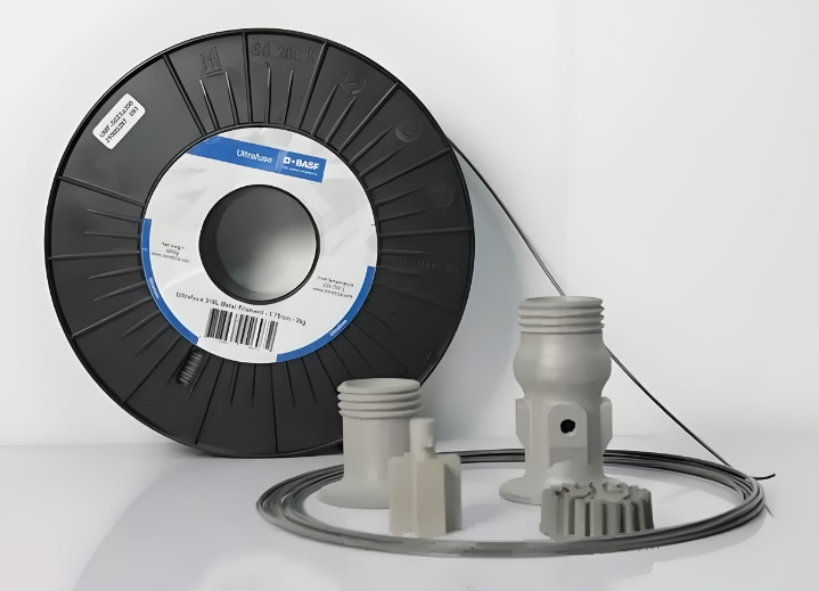
Typically the metal filament 3D printing metal is a composite of metal powder and a polymer binder. These composite filaments can be printed on typical Fused Deposition Modeling (FDM) 3D printers, such as the Raise3D E2 printer. We use BASF Ultrafuse 316L metal filament for 3D printing metal in our metal 3D printing workshop. The BASF Ultrafuse 316L metal filament is a popular metal-polymer composite for additive manufacturing with metal.
2. ADVANTAGES OF METAL FILAMENT 3D PRINTING
• Cost-Effective Production: The most traditional of metalworking can be expensive and lead to high waste levels and therefore lots of labor to produce. But the production of metal parts with a 3D printer is cost efficient and also produces less waste then the traditional production methods.
• Customized production parts: For a wide variety of industries metal filament additive printing can be used for customized production parts. Such parts can be made just for certain applications or needs.
• Speed: Prototype and produce objects in a much faster time frame, enabling you to test, re-make and complete production objects in no time.
3. KEY APPLICATIONS ACROSS INDUSTRIES
• Aerospace: Lightweight parts with complex internal structures that are strong under extreme conditions.
• Medical Devices: Customized, biocompatible metal implants and prosthetics for individual patients.
• Automotive: Production of high-performance durable parts for both testing of functional prototypes and the final production.
• Jewelry: Metal filament additive manufacturing can be used to make jewelry because complex designs can be printed quickly and cost effectively.
4. LEADING 3D PRINTERS FOR METAL FILAMENT FABRICATION
Markforged Metal X: The Precision Standard
The Markforged Metal X is a powerful 3D printing machine. It has an easy-to-use interface, and is robust enough to be used as a production tool.
• Build Volume: 300 x 220 x 180 mm.
• Materials: Stainless steel, tool steel, Inconel, titanium, and copper.
• Software: Eiger software simplifies printing with intuitive controls and real-time monitoring.
Raise3D E2: Versatile Dual Extrusion
Raise3D E2 Dual Extrusion 3D Printer for Metal Filament Printing. The Raise3D E2 3D printer can be used to print with BASF Ultrafuse 316L metal filament and other similar metal filaments.
• Principal Benefit: Dual extrusion allows for printing complex geometries with dedicated support materials.
• Build Volume: 330 x 240 x 240 mm.
Ultimaker S5: Reliable Low-Volume Production
FDM printing of high quality with good detail resolution.
• Principal Benefit: Extensive material compatibility and advanced Cura material profiles for metal composites.
Metal 3D Printing: Important to Note – As mentioned before, about 80% of all the desktop 3D printers on the market today can print with the “filaments” listed above (including the “metal filament”); however, as also previously stated, printing “green parts” as they are (i.e. without going through the professional high-temperature annealing process – which includes the processes of debinding and sintering in order to remove the polymers and to fuse the metal particles together) will result in very fragile parts that will likely break easily. Thus, the printing of metal parts using metal filament printing needs to be left to the professional service providers.
5. THE FUTURE LANDSCAPE OF METAL ADDITIVE MANUFACTURING
Metal filament 3D printing is developing at a fast pace. New developments in the field of materials, 3D printing machines and post-processing will appear in the near future.
• Material Innovations: The use of new metal filaments is a constantly evolving field. The emerging materials will have enhanced properties, enabling the production of metal parts of even greater strength, electrical conductivity and corrosion resistance.
• Multi-Material Printing: As metal filament printing technology evolves, it is expected to allow for the printing of multiple materials simultaneously, allowing for the creation of metal parts made of composite materials.
• Larger Scale Printing: The future development of metal filament 3D printing technologies such as for larger 3D printing machines to manufacture bigger metal parts.
Large scale printing as well as integration into existing manufacturing systems to create hybrid processes, where metal filament printing can leverage the strength of traditional manufacturing methods to create parts that would otherwise be difficult to make.
CONCLUSION
As metal filament printing technology continues to evolve, it will revolutionize manufacturing for the production of complex, customized, high performance metal parts, making manufacturing more efficient, cost effective and diverse than ever before.
Act early to utilize the metal filament additive manufacturing technology for your projects. We will continuously monitor its development and pass on its advantages to you.